60+ SEO Statistics for 2026: AI Overviews, Rankings and GEO

Your rankings look fine. But your traffic keeps dropping.
For a complete walkthrough, see our guide: How to Set Up Google Analytics 4 and Connect it to Your WordPress Site?.
It is the new normal. About 65% of Google searches end without a click. AI answers now appear on more than half of all queries. Fewer than 1 in 5 pages that rank #1 are ever cited by an AI engine.
If you are still measuring SEO the same way you did two years ago, you are missing what actually matters now. This article gives you 60+ verified SEO statistics for 2026, covering Google rankings, AI Overviews, Local SEO, Mobile SEO, Voice SEO, Video SEO, B2B SEO, and GEO. Every stat links to its source. Every section ends with a clear next step.
SEO Statistics (TOC):

Quick Summary: The 12 SEO Stats That Define 2026
These twelve numbers cover the full SEO picture right now. Read them first to frame your strategy, then dig into each section for the full data.
| Metric | 2026 Figure | Verified Source |
|---|---|---|
| Zero-click rate (all Google searches) | ~65% end without a click | SparkToro / Digital Applied |
| AI Overviews: search coverage | 58% of all Google searches show an AIO | Ahrefs, Feb 2026 |
| AIO zero-click rate | 83% of AIO queries end with no click | Similarweb / Click Vision, 2026 |
| AI Mode zero-click rate | 93% end without a click | Semrush, Sep 2025 |
| Organic CTR drop with AIO present | -61% (from 1.76% to 0.61%) | Seer Interactive, 2025 |
| Top organic position CTR | 27.6% desktop / 22.4% mobile | Backlinko, 2026 |
| Mobile share of Google searches | 63-71% of all queries from mobile | SQ Magazine / Statista, 2026 |
| Google global market share | 90%+ across all devices (Jan 2026) | StatCounter, 2026 |
| AI search traffic growth YoY | +527% | Previsible, 2025 |
| GEO: 3+ tables citation lift | +25.7% more AI citations | AirOps, April 2026 |
| AI visitor conversion vs. organic | 23x higher conversion rate | Ahrefs, 2025 |
| Google / AI SERP overlap | <20% of Google #1 pages cited by AI | Brandlight, 2026 |
General Google SEO Statistics for 2026
Google still controls over 90% of search. But what each ranking position actually delivers has changed. AI features now take up more of the page, and organic clicks have dropped.
Google Market Share and Search Volume
Google holds 90.04% of global search engine market share, as of January 2026. On mobile, that number goes up to 94.6%. No other search engine is close enough to matter for most businesses.
• Google handled about 5.9 trillion searches in 2025, up from 5 trillion the year before. That is roughly 16.4 billion searches every single day.
• 15% of all daily Google searches are completely new queries. Google has never seen them before. Fresh, specific content has a real chance to rank every day.
• Only 0.44% of searchers ever look at page 2. If you are not on page one, almost no one will find you.
Organic CTR by Ranking Position
Ranking #1 on Google still pays off more than any other position. The jump from #2 to #1 gives you 74.5% more clicks. But when AI Overviews appear on the page, even the top spot loses a big chunk of traffic.
• The #1 result gets a 27.6% click-through rate on desktop. On mobile it drops to 22.4%, then 13% at position #2, and just 2.3% by position #10.
• The top 5 results take 67% of all clicks. Positions 6 to 10 split the remaining 33%.
• SEO delivers about 8x ROI, which is roughly twice the return of paid search. The value keeps growing over time.

Content Length, Backlinks, and Authority
Longer, deeper content wins on every metric. More links, more traffic, more AI citations. Depth is what Google and AI engines both reward.
• Content over 3,000 words earns 3x more traffic, 4x more shares, and 3.5x more backlinks. Depth signals authority to Google and to AI engines.
• Pages that rank first hold 3.8x more backlinks than pages in positions 2 to 10. Backlinks remain one of the strongest ranking signals.
• 95% of all indexed pages have zero backlinks. Most content earns nothing from links. Active link building is still a must.
• Refreshing old content can drive up to 146% more organic traffic. Updating an existing article often beats writing a new one at the same cost.
• 91.8% of all searches include long-tail keywords. Long-tail terms also convert 2.5x better than short, broad ones.
Where to focus: Pick your top 20 articles and check when each was last updated. Anything older than 12 months with stale stats or missing links is a refresh candidate. The 146% traffic lift from a good update almost always beats starting from scratch.
| Google SEO Metric | 2026 Figure | Source |
|---|---|---|
| Position #1 desktop CTR | 27.6% | Backlinko |
| Position #1 mobile CTR | 22.4% | Semrush, 2026 |
| Top 5 results: share of all clicks | 67% | Advanced Metrics |
| Pages with zero backlinks | 95% | Ahrefs, 2026 |
| Content refresh traffic lift | Up to 146% | DemandSage, 2026 |
| Long-tail keyword share of queries | 91.8% | Backlinko, 2026 |
| Brand-new queries per day | 15% of all searches | |
| Searchers who reach page 2 | 0.44% | Backlinko, 2026 |
AI SEO Statistics: Overviews, Zero-Click, and What Changed
AI Overviews now appear on 58% of Google searches. The zero-click rate has passed 65%. At the same time, AI search traffic is growing 527% year over year — and those visitors convert better than standard organic.
Ranking well and getting real traffic are no longer the same thing.
Zero-Click Search in 2026
Zero-click search is not new. But it is growing faster than ever. Featured snippets and knowledge panels already kept users on Google. AI Overviews have pushed that even further.
• About 65% of all Google searches end without anyone clicking a link, up from 50% in 2019. Every new SERP feature pushes this number higher.
• When an AI Overview is on the page, that zero-click rate rises to 83%. Only 1 in 6 users clicks through to a website.
• Google AI Mode is even more extreme: 93% of AI Mode sessions end without a single click. It is the most contained search experience ever measured.
• On mobile, more than 77% of searches produce zero clicks. Mobile users accept AI answers at a higher rate than desktop users.
Zero clicks do not mean zero value. When your brand shows in an AI Overview, users see it without clicking. The real damage is to mid-funnel traffic, not brand awareness.

How AI Overviews Are Changing Organic CTR
AI Overviews went from a small experiment to the dominant SERP feature in 18 months. They now appear on the majority of searches. Organic CTR drops sharply when they are on the page.
• AI Overviews now appear on about 58% of all Google searches. That is up from near zero in 2023.
• When an AI Overview appears, organic CTR drops 61%, falling from 1.76% to 0.61% across 25.1 million tracked impressions.
• It is not just AI-enhanced pages that are affected. Queries without AI Overviews also saw organic CTR fall by 41%. User behaviour has shifted across all of search.
• Pew Research Center found only 1% of users click source links inside AI Overviews, based on a study of 68,879 real queries.
• Pages cited inside an AI Overview earn 35% more organic clicks than pages that appear below the overview. Being inside the answer matters more than ranking just below it.
• More than half of desktop AI Overviews do not link to the #1 ranked page. A page in position 4 can appear inside an AI Overview ahead of the page in position 1.
AI Referral Traffic: Small Volume, High Quality
AI referral traffic is still a small share of total visits. But the quality is unlike anything in standard organic search.
• Ahrefs data shows AI-referred visitors convert 23x higher than organic search visitors. They also bounce less and stay longer on the page.
• 87.4% of all AI referral traffic comes from ChatGPT. ChatGPT holds 68% of the AI chatbot market and is now the fourth most visited site in the world.
• 28.3% of ChatGPT’s most-cited pages have zero organic visibility on Google. Ranking on Google and being cited by AI are two completely separate outcomes.
• Only 10% of ChatGPT results on short-tail queries overlap with Google SERPs. Both channels need their own strategy.
If you run a WordPress site, knowing which articles actually drive traffic is the first step. Analytify’s GA4 organic traffic report shows per-post data directly inside your WordPress editor, so you can see what is working and what needs a refresh.
| The extractability gap 85% of pages that AI Overviews retrieve are never cited in the final answer. A page at Google position #1 has a 58% chance of being cited. By position #10, that drops to 14%. The gap between being retrieved and being cited comes down to content structure, not domain authority. |
Local SEO Statistics for 2026
Local SEO has one big advantage most people miss. Only 7.9% of local searches trigger an AI Overview, compared to nearly 100% for informational queries. Local results still show up where they always have.
For businesses with a physical location, local SEO is one of the most reliable channels you have right now.
How Much Local Search Actually Happens
• 46% of all Google searches have local intent. Nearly half of all 5.9 trillion annual queries involve someone looking for something nearby.
• 1.5 billion ‘near me’ searches happen every month globally, which works out to about 50 million location-based searches every single day.
• ‘Near me’ searches have grown over 900% in recent years. No other search category has grown this fast.
• 80% of US consumers search for a local business at least once a week. Local search is a habit, not an occasional lookup.
What Happens After a Local Search
Local search data is different. The gap between search and purchase is very short. These are same-day buying signals.
• According to Google, 76% of people who do a ‘near me’ search visit a business within 24 hours. No paid channel converts awareness to a physical visit this fast.
• 28% of local searches lead to a purchase on the same day. More than 1 in 4 local queries closes as a transaction the same day it was searched.
• 88% of consumers who do a local smartphone search visit or call a business within 24 hours. Mobile local search has the highest intent-to-action rate of any search type.
• 78% of local mobile searches result in an offline purchase. Local search converts to in-store revenue at a rate paid ads cannot reliably match.

Google Business Profile and Reviews
• 86% of people use Google Maps to find a business location. A complete Google Business Profile directly affects whether you show up in Maps results.
• BrightLocal found 99% of consumers read reviews before visiting a local business. Reviews are now a basic requirement, not a nice-to-have.
• 68% of consumers will not consider a business rated below 4 stars. Your star rating affects whether you make the shortlist before any search algorithm does.
• Businesses in the Local Pack get 126% more traffic than standard organic listings. Getting into the Pack roughly doubles the traffic you get from a regular organic ranking.
• 42% of all local searches result in a click on a Local Pack listing. The Pack takes most of the local search engagement before organic results are even seen.
Recommended next step: Claim your Google Business Profile and fill it out completely. Choose the most accurate primary category. Add photos and service descriptions. Post regular updates. Review velocity (recent reviews, not just total count) is one of the top Local Pack ranking signals.
Mobile SEO Statistics for 2026
Google uses mobile performance to rank your site everywhere, not just on phones. Between 63% and 71% of all Google searches now come from mobile. Mobile behaviour is different from desktop, and your site needs to handle both.
Mobile Search Volume and Page Speed
• Between 63% and 71% of all Google searches come from mobile devices, depending on the region. Mobile is now the main way people search.
• 94.6% of all mobile searches go through Google. There is almost no case for optimizing mobile presence on any other engine.
• Google research shows 53% of mobile sessions are abandoned when a page takes more than 3 seconds to load. Speed is a revenue issue, not just a technical one.
• Every one-second improvement in load time increases conversions by 7%. The relationship between speed and sales is direct and consistent.

How Mobile Users Search and Behave
Mobile sessions are shorter and more focused than desktop sessions. Users come with a specific intent and leave quickly if the experience is poor.
• More than 75% of mobile searches produce zero clicks. Mobile users accept AI-generated answers more readily than desktop users.
• Mobile users average 3 pages per session, compared to 4 to 7 on desktop. Structure and clarity matter more than length on mobile.
• Over 20% of searches on the Google App now use voice input. Mobile SEO and voice SEO are now the same problem.
• Google Lens handles over 20 billion visual searches every month. 62% of shoppers prefer visual search when looking for products.
Practical step: Check your Core Web Vitals on mobile in Google Search Console every month. Aim for an LCP under 2.5 seconds and no mobile usability errors. Compress images to WebP, delay non-critical scripts, and use a CDN. Speed is a confirmed ranking factor, not just a best practice.
| Mobile SEO Metric | 2026 Figure | Source |
|---|---|---|
| Share of Google searches (mobile) | 63-71% | Statista / SQ Magazine |
| Google mobile search market share | 94.6% | StatCounter, 2026 |
| Sessions abandoned if load > 3 seconds | 53% | Google / Think With Google |
| Mobile searches: zero-click rate | >75% | SparkToro / Backlinko, 2026 |
| Google App searches using voice | >20% | Google, 2026 |
| Mobile pages per session | 3 (vs. 4-7 desktop) | Coalition Technologies, 2026 |
| Conversion lift per 1-second improvement | +7% | Akamai, 2026 |
Voice SEO Statistics for 2026
There are now more active voice assistants in the world than there are people. Voice search is part of everyday life. Most sites are still not optimised for it. That is a real opportunity.
How Many People Use Voice Search
• There are 8.4 billion active voice assistants worldwide in 2026. That is more than the global population.
• 52% of people globally use voice search daily or almost daily. For most users, voice is not a backup option. It is a first choice.
• Google data confirms 70% of voice queries use natural, conversational language. Standard keyword-focused content misses most voice searches entirely.
• Voice queries are 20 to 35% longer than typed searches. Question-based content works for both typed and spoken queries at the same time.
• Gen Z uses voice search 40% more than Boomers. The largest spending generation coming up is the most voice-native one.

Voice Search, Local Intent, and Schema
Most voice searches are not general questions. They are local and immediate. Someone asking their phone where to eat or what time a store closes is ready to act, not just browse.
• 76% of all voice queries have local intent. The majority of voice search volume is driven by people looking for something nearby.
• 58% of consumers use voice search to find details about local businesses. Businesses without voice-optimised content are handing that traffic to competitors.
• 40.7% of voice search answers come from featured snippets. Winning a featured snippet is the main path to voice search visibility.
• Pages with schema markup are 33% more likely to appear in voice results. HowTo schema have the strongest connection to voice search eligibility.
• Voice commerce reached $4.6 billion in 2026, up 215% year over year. It is on track to reach $164 billion by 2028.
What this means for your content team: Write FAQ sections the way people actually speak, not how they type. Use question-based H2 and H3 headings. These changes help voice search, AI Overviews, and featured snippets all at once.
Video SEO Statistics for 2026
Google shows video results for more than 62% of all keyword searches. YouTube handles over 3 billion searches a month and has 2.53 billion monthly active users. Adding video to existing content is one of the easiest wins in organic search.
What Video Does for Rankings and Conversions
• Forrester Research found pages with video are 53 times more likely to rank on Google’s first page. That is not a small edge. It is a structural advantage.
• Video content drives 157% more organic traffic from search results. Adding video to a high-traffic page is one of the fastest ways to grow its reach.
• Websites using video report an average 80% increase in conversion rates. Video keeps people on the page longer and pushes more of them to take action.
• HubSpot’s State of Marketing research shows short-form video delivered the highest ROI of any content format in 2024, confirmed by 17% of marketers as their best-performing format.

YouTube SEO and Visual Search
YouTube is the second-largest search engine in the world. It also plays a growing role in AI search results. That makes it one of the few content investments that pays off in both traditional SEO and GEO at the same time.
• YouTube is the top click destination from Google’s traditional search results. In every global region measured, it gets more Google referral clicks than any other site.
• YouTube and Reddit together account for 78.2% of all AI social media citations. A well-optimised YouTube video is both an SEO asset and a GEO asset.
• Google Lens handles over 20 billion visual searches every month. 62% of shoppers prefer visual search when they are looking for a product to buy.
Strategic takeaway: Embed YouTube videos on your best-performing pages. Optimise video titles and descriptions with your target keywords. Add chapter timestamps so viewers can navigate. Repurpose transcripts as page copy for extra keyword coverage.
B2B SEO Statistics for 2026
71% of B2B researchers start their buying journey with a generic Google search, not a brand name. Most vendors are not the first stop. Buyers do research before reaching out, and search is where that research starts.

B2B Search Behaviour and Buying Patterns
• Google research confirms 71% of B2B researchers start their journey with a generic search. Most B2B buyers find vendors through organic search before they ever hear the brand name.
• B2B buyers conduct an average of 12 searches before engaging a specific brand. If you are not visible early in that research process, you are not getting on the shortlist.
• BrightEdge data shows SEO drives over 1,000% more traffic than organic social media for B2B companies. The gap between organic search and social is an order of magnitude.
• 61% of B2B marketers say SEO brings more leads than any other channel. Organic search is the leading B2B lead source by a clear margin.
• 60% of B2B buyers say mobile played a significant role in a recent purchase decision. Mobile optimisation is a pipeline requirement in B2B, not an optional upgrade.
B2B Content Strategy and Publishing Frequency
Publishing consistently in B2B SEO creates a compounding traffic advantage. More content means more traffic, more links, and more AI citations.
• 92% of B2B marketers use blog posts and short articles in their content strategy. Blog content is the dominant B2B SEO format by a wide margin.
• B2B companies that publish 9 or more posts per month get 20.1% more yearly Google traffic. Publishing frequency compounds into an advantage that grows over time.
• BuzzSumo research shows articles with statistics earn 149% more social shares and 283% more backlinks. Original data is the highest-value content format in B2B SEO.
• B2B technology queries triggered AI Overviews in 82% of cases by March 2026, up from 36% at the start of the year. B2B tech is the fastest-growing AI Overview category.
• B2B SaaS companies report 6 to 27 times higher conversion rates from AI-referred traffic. AI referrals are low in volume but very high in quality.
If you want to see which B2B content is actually driving conversions and not just traffic, Analytify’s GA4 checkout funnel tracking shows which organic articles complete conversion paths. You can see this data directly inside WordPress, without switching tabs or exporting reports.
| B2B SEO Metric | 2026 Figure | Source |
|---|---|---|
| B2B buyers starting with generic search | 71% | |
| Searches before engaging a brand | 12 on average | Google, 2026 |
| SEO vs. social traffic advantage | 1,000%+ | BrightEdge, 2026 |
| B2B marketers using content marketing | 92% | CMI, 2026 |
| Traffic lift: 9+ posts per month | +20.1% yearly | StrataBeat, 2026 |
| Backlink lift: articles with statistics | +283% | BuzzSumo |
| B2B tech AI Overview coverage | 82% of queries (March 2026) | SEJ, March 2026 |
| AI referral conversion vs. organic (B2B) | 6x to 27x higher | SEOmator, 2026 |
GEO Statistics: How to Get Cited by AI Engines in 2026
GEO stands for Generative Engine Optimisation. It means writing and structuring content so AI engines do not just find it, but actually cite it. 85% of pages AI Overviews retrieve never appear in the final answer. Structure, not domain authority, is what makes the difference.
Here is what the data says about getting cited.
How AI Citation Works
Most SEO professionals assume AI citation follows ranking logic. It does not. Google position and AI citation have a weak link. Page structure matters more than domain power.
• Kevin Indig’s analysis of 1.2 million answers found 44.2% of ChatGPT citations come from the first 30% of a page. If your article buries the main point, AI engines skip it.
• A page at Google position #1 has a 58% chance of being cited by AI. By position #10, that drops to 14%.
• 43.2% of pages ranking #1 on Google are also cited by ChatGPT, which is 3.5x higher than pages outside the top 20. But ranking alone is not enough to guarantee citation.
• 28.3% of ChatGPT’s most-cited pages have no organic visibility on Google at all. Ranking on Google and being cited by AI are two completely separate things.
Content Structure Changes That Increase AI Citation
Three structural changes get you cited more. None of them require new content. You can make all three in a single editing pass.
• Comparison pages with 3 or more tables earn 25.7% more AI citations. Tables are the most impactful single structural element for GEO.
• Pages with 8 or more list sections earn 26.9% more AI citations. Structured lists give AI parsers clean, individual items to extract.
• Pages with an average sentence length under 10 words earn 18.8% more AI citations. Short sentences are easier for AI systems to parse quickly and accurately.
• Comparison and ‘vs.’ articles trigger a ChatGPT web search 100% of the time. Head-to-head content is the format most certain to trigger AI retrieval.
• GEO citation data decays within 13 weeks without a content refresh. AI engines move away from stale pages faster than Google does. A quarterly update schedule is a minimum.
• 65% of marketers say AI-driven search changes are their biggest challenge in 2026. GEO has moved from an experiment to a primary priority in under 12 months.

Topical Authority, Schema, and GEO Infrastructure
A low-authority site with deep topical coverage regularly beats a high-authority site with thin content. AI engines prioritise depth over domain power.
• A DA 20 site with a deep content cluster earns 3.2x more AI citations than a DA 80 site with surface-level coverage. Topical depth beats domain authority in how AI engines decide what to cite.
• The GEO market is projected to grow from $886 million in 2024 to $7.3 billion by 2031, at a 34% annual growth rate. GEO is no longer experimental. It is a budget line.
• 86% of SEO professionals have integrated AI into their workflows. Using AI in SEO is now standard. The difference is in how well it is applied.
Where to start with GEO: Open each article and read only the first sentence after every H2 heading. If that sentence does not directly answer what the heading asks, rewrite it. This one edit (the ski ramp rule) is the highest-value GEO improvement you can make on any existing article.
| GEO Optimisation Factor | Citation Impact | 2026 Source |
|---|---|---|
| Comparison page with 3+ tables | +25.7% AI citations | AirOps, April 2026 |
| Page with 8+ list sections | +26.9% AI citations | AirOps, April 2026 |
| Avg. sentence length under 10 words | +18.8% AI citations | AirOps, April 2026 |
| First 30% of content | 44.2% of all ChatGPT citations | Kevin Indig, 2026 |
| Deep cluster vs. surface coverage | 3.2x more AI citations | HubSpot / XICTRON, 2026 |
| Content without a quarterly refresh | Decays within 13 weeks | GEO research, 2026 |
| Comparison / ‘vs.’ content | 100% AI web search trigger | Writesonic, March 2026 |
| Being cited in an AI Overview | +35% organic CTR | SEOmator, 2026 |
How to Track SEO Performance in WordPress with Analytify
Knowing what the 2026 SEO statistics say is useful. Knowing which of your own articles are actually benefiting from organic search is what changes your decisions.
With zero-click rates past 65% and AI Overviews appearing on 58% of queries, rankings alone no longer tell you whether your SEO is working. You need to see which articles are pulling real traffic and which are quietly losing ground.
Analytify connects your WordPress site to GA4 and shows you that data directly inside your editor. No tab switching, no exports, no separate dashboard.
See Per-Post GA4 Data Without Leaving WordPress
Analytify shows pageviews, sessions, bounce rate, and traffic source for each individual article, right inside your WordPress admin. You can check performance while you edit, before you publish, or during a content audit.
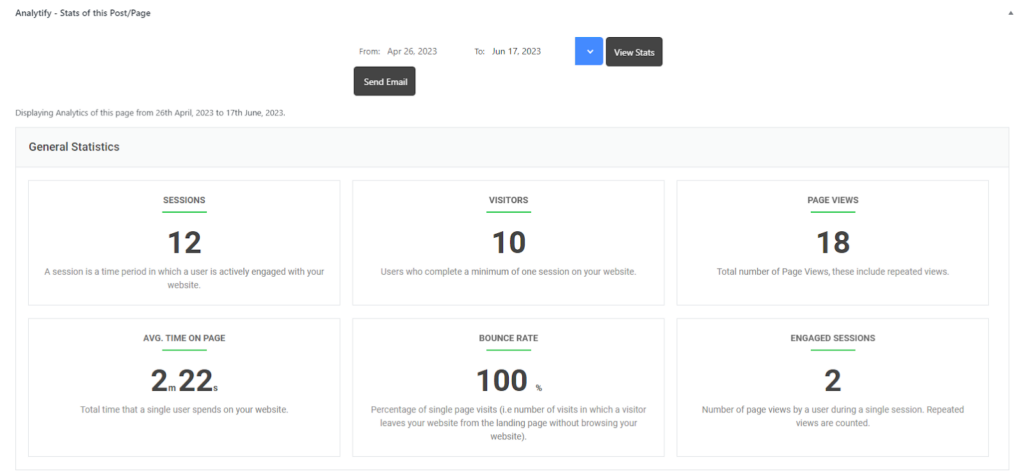
For a site running a quarterly content refresh cycle (which the GEO decay data in this article strongly suggests), this changes how you prioritize. Instead of guessing which articles need updating, Analytify shows you the ones with declining organic sessions over the past 30, 60, or 90 days. Those are your refresh targets. The ones with growing sessions are working. Leave them alone and focus effort on the ones slipping.
You can also see traffic at a glance across your full blog list, sorted by any metric. For a content lead managing a team of writers, this replaces a manual Google Analytics deep-dive with a two-minute check inside WordPress.
Track Organic vs. AI Referral Traffic per Post
Analytify pulls GA4 channel data for each article, so you can see whether traffic is coming from organic search, direct, referral, social, or AI sources. As AI referral traffic grows (up 527% year over year, as covered above), separating it from organic search is no longer a nice-to-have. Mixing the two in a single ‘traffic’ number hides what is actually working.
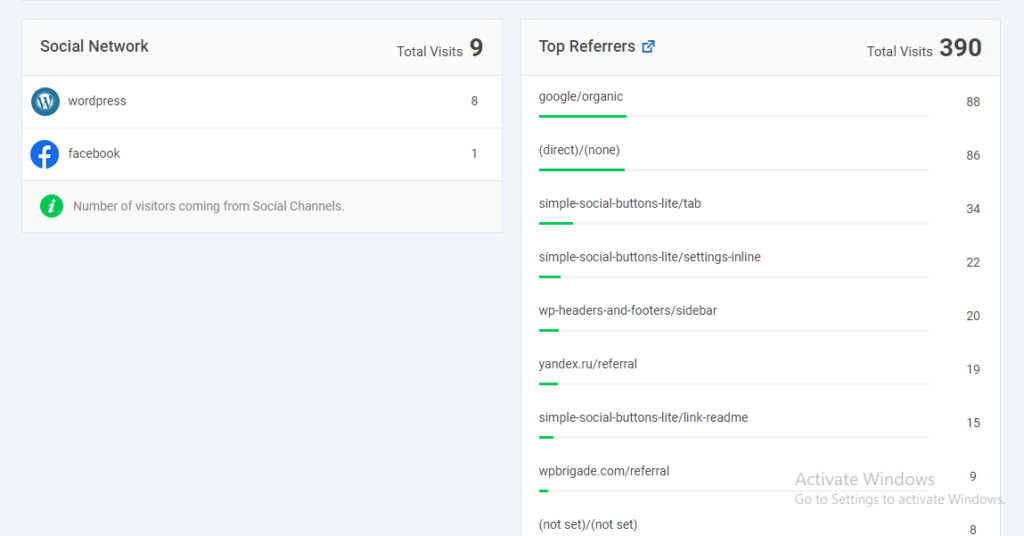
If an article is gaining AI referral sessions while losing organic sessions, that tells you something specific: the article has good GEO structure but may be losing Google ranking. The fix is different from an article that is losing both. Analytify gives you the per-channel breakdown to make that call quickly.
You can also monitor which traffic sources convert. AI-referred visitors convert at rates far above organic search averages. Seeing which of your articles attracts that high-intent traffic tells you where to invest more content effort.
Monitor WooCommerce Conversions from Organic Content
If your site sells products, Analytify’s WooCommerce tracking shows which organic blog posts are completing purchase journeys. The B2B SEO data earlier in this article confirms that 61% of marketers say organic search brings more leads than any other channel. Analytify makes that verifiable at the individual article level, not just the site level.

You can see which articles drive add-to-cart events, checkout completions, and revenue directly from the WordPress post list. If a product guide is sending buyers through the funnel but a category page is not, that is content strategy data, not just analytics data.
For WordPress site owners managing both content and sales, Analytify closes the gap between writing and results.
Frequently Asked Questions About SEO Stats and GEO Statistics
These are the most common questions about SEO and GEO in 2026.
What are the most important SEO statistics to know in 2026?
Three numbers define 2026 SEO. Zero-click rate: 65% of searches end without a click. AI Overview impact: organic CTR dropped 61% when AI Overviews appear. GEO citation lift: pages with 3+ tables earn 25.7% more AI citations.
How do Google SEO statistics differ from AI SEO statistics in 2026?
Google SEO statistics measure traditional performance: rankings, CTR, backlinks, and traffic. AI SEO statistics measure whether your content gets cited by AI engines like ChatGPT, AI Overviews, and Perplexity. Only 20% of Google’s top-ranked pages overlap with what AI systems cite. Both need different structures and different update schedules.
What do Local SEO statistics tell us about AI search in 2026?
Local SEO is one of the most AI-resistant categories in search. Only 7.9% of local searches trigger an AI Overview, compared to nearly 100% for informational queries. Local results still show up where they always have. Google Business Profile completeness, review management, and consistent NAP data remain the primary ranking drivers.
Which B2B SEO statistics show the strongest channel ROI?
SEO drives over 1,000% more traffic than organic social media for B2B companies (BrightEdge). 61% of B2B marketers say organic search brings more leads than any other channel. Publishing 9 or more articles per month drives 20.1% more yearly Google traffic. For GEO, articles with original statistics earn 283% more backlinks and get cited most by AI engines.
What Video SEO statistics matter most in 2026?
Pages with video are 53x more likely to rank on the first page of Google (Forrester). Video drives 157% more organic traffic from search. YouTube and Reddit together account for 78.2% of AI social media citations. A well-optimised YouTube video works as both an SEO and a GEO asset.
Why isn’t my content getting cited by AI even though it ranks well on Google?
The most common reason is poor content structure, not low authority. 85% of pages AI Overviews retrieve are never cited. Typical failures: the first sentence after a heading does not answer the question, sentences average over 10 words, fewer than 3 tables in the article. All fixable without a full rewrite.
How often should SEO content be updated in 2026?
Every 90 days, at minimum, for any article targeting AI citation. GEO citation data decays within 13 weeks. AI engines move away from stale pages faster than Google does. A refresh on a high-traffic article can drive up to 146% more organic traffic. For statistics articles, a 6-month full update with fresh sources keeps both rankings and AI citation rates stable.
SEO Statistics: Conclusion
The 2026 SEO data points in one direction. Rankings still matter. They are the strongest predictor of AI citation. But ranking well no longer guarantees traffic, and traffic no longer tells you if you are visible in AI answers.
Zero-click search has passed 65%. AI Overviews appear on 58% of queries. AI search traffic is growing 527% year over year. And fewer than 1 in 5 pages that rank #1 on Google are cited by an AI engine. SEO and GEO now need to run at the same time, not one after the other.
If you run a WordPress site, LoginPress keeps your login page secure and on-brand. That frees your content team to focus on search visibility, AI citation, and measurable traffic.
Three clear actions come from the data in this article:
- Refresh your top articles for GEO structure. Rewrite the first sentence after every H2 to directly answer the heading’s question. Add tables to comparison pieces. Use Analytify’s GA4 organic traffic reporting inside WordPress to find which articles need the most attention.
- Track AI visibility alongside Google rankings. Monitor whether your brand appears in AI-generated responses, not just in rank trackers. Use GA4 checkout funnel data to see whether organic traffic is turning into revenue.
- Update content on a 90-day cycle. GEO citations decay within 13 weeks. Quarterly updates with fresh sourced data keep both Google rankings and AI citation rates stable. For more tactics, see our guide on how to increase website traffic on WordPress.
Download Analytify and see per-post GA4 data, including traffic, events, and conversions, without leaving your WordPress editor.
You may like to read: