Best SEO API (2026): Technical Review of Top Data Providers

Picking an SEO API is mostly a billing problem, not a feature problem. Every provider sells keyword, backlink, and SERP data. The real gap is how much they charge, how hard they throttle you, and which AI features they bundle in.
This review ranks the best SEO API options for 2026 by real cost, rate limits, and AI search features.
You’ll get a side-by-side comparison table, a technical breakdown of SE Ranking, Ahrefs, DataForSEO, Semrush, and Bishopi, a use-case decision guide, and where an on-site analytics layer fits once your traffic lands.
Best SEO API (TOC):
What Is the Best SEO API?
SE Ranking API is the best SEO API for SEO experts and teams. SE Ranking API operates as a completely standalone data product. You can purchase access without maintaining an active software subscription. The pricing relies on a credit allocation system starting at $318.00 annually for 24 million credits. Its standout feature is the native Model Context Protocol (MCP) server. This technical bridge connects your databases directly to AI assistants like Claude Desktop and Gemini CLI.
Developers pull live keyword volumes, check backlink metrics, and run technical audits using plain English prompts. Simple SERP records consume exactly 10 credits per call. The platform also tracks AI search visibility. This lets you monitor how often your brand actually appears in generative LLM overviews.
Building marketing software is hard. You need a SERP data API for raw search results. You need keyword search volumes. You need backlink graphs. Building these crawlers from scratch burns cash quickly. For most teams, renting access through specialized endpoints is the more practical path. These vendors maintain massive server clusters. They handle proxy rotation automatically. They parse messy HTML DOM structures into clean JSON objects. Your application just sends a POST request and receives structured text. It sounds simple. The billing is where it gets complicated.
Vendors obscure their actual costs behind confusing credit systems. Some platforms force you into massive monthly subscriptions before giving you a single production key. Others offer cheap pay-as-you-go systems that secretly charge extra for fast responses. To cut through that, we analyzed SE Ranking, Ahrefs, DataForSEO, Semrush, and Bishopi.
Best SEO APIs Comparison Table
This table compares base pricing, billing model, AI features, rate limits, and the ideal use case for each provider at a glance.
| Platform | Base Pricing | Pricing Model | AI/LLM Features | Rate Limits | Primary Use Case |
|---|---|---|---|---|---|
| SE Ranking | $318.00/mo (Annual) | Subscription / Add-on | MCP Server, AI Search Visibility | Endpoint dependent | Standalone data access & AI agent integration |
| Ahrefs | $1,499.00/mo | Enterprise + Units | Brand Radar, Prompt Tracking | 60 requests/minute | Massive enterprise scale & backlink research |
| DataForSEO | $50.00 deposit | Pay-as-you-go | LLM Mentions, AI Keyword Data | Custom headers | Headless scraper builds & custom apps |
| Semrush | $499.95/mo | Business Plan + Units | AI Search Health Audit | 10 requests/second | Agency reporting & clickstream data |
| Bishopi | $49.00/mo | Tiered / Credits | Basic Market Intelligence | Tier dependent | Domain investing & freelance analysis |
Let’s break down each provider, starting with our top pick.
1. SE Ranking API

SE Ranking API is the best overall SEO API for teams that want standalone data plus native AI-agent access. SE Ranking provides a standalone interface for teams needing direct AI agent support without buying a full dashboard subscription. The architecture connects straight to Claude Desktop via an authenticated Model Context Protocol server. This speeds up reporting flows considerably. Developers pull live keyword volumes using plain English prompts instead of rigid code. It handles backlink analysis cleanly.
What Are the Key Features of SE Ranking API?
- Model Context Protocol (MCP) Server: SE Ranking connects directly to AI assistants via an authenticated remote MCP spec. Claude Desktop and Gemini CLI use this transport layer to query live databases. Instead of logging into a dashboard and clicking buttons, a programmer types a plain English request. The AI agent fetches the live metrics directly. This reduces standard keyword research time from forty-five minutes to under five minutes.
- AI Search Visibility Tracking: The endpoints track brand mentions across various generative engines. You can pull precise statistics on how often your brand appears in AI overviews. The system returns the exact citations used by the machine learning models.
- Regional Keyword Database Support: The domain and keyword research endpoints support specific ISO 3166-1 alpha-2 regional codes. Passing an unsupported code immediately returns a 400 Invalid source error. This strict validation prevents wasted credits on broken queries.
- Complete Project Management: The system exposes full CRUD operations for tracker campaigns. You can create LLM engines, update tracker settings, and delete specific prompts via automated scripts. This makes it an ideal best SEO API for dynamic reporting apps.
- Native Webhook Architecture: The backend connects directly to automation platforms like Make, n8n, and Zapier. This allows instantaneous data pushing without aggressive API polling. You register a callback URL. The server posts the JSON payload to your destination when the scraping job finishes.
- Extensive Backlink Indexing: The database contains over 2.7 trillion links. It identifies referring domains, destination URLs, and calculates specific Domain InLink Rank scores on a 0-100 scale.
- Website Audit Specificity: The crawler endpoints return highly structured issue codes. This allows an external SEO analyzer API to map proprietary error messages directly to internal developer tracking boards.
What Are the Pros and Cons of SE Ranking API?
Pros:
- This is a highly reliable best SEO data API because it operates as a standalone product. You don’t need an active platform subscription to buy raw access.
- Developers consider it the best API for SEO when building AI tools. The native MCP server provides 160 distinct functions ready for LLM consumption immediately.
- The search engine rankings API uses a straightforward credit calculation. Simple SERP lookups cost exactly 10 credits.
- It offers smooth SEO API integration with a generous 14-day trial. They give you 100,000 free credits to test your scripts.
- Comparing best SEO API providers reveals that their documentation is extremely clear regarding error handling and rate limit headers.
- These SEO data API providers offer flexible add-ons. You can upgrade monthly limits easily.
- True SEO API automation relies on fast authentication. They support standard Authorization headers using bearer tokens.
Cons:
- The SEO optimization API identifies broken structural elements. Still, you have to write custom Python scripts to parse the deep nested arrays.
- It’s a capable SEO API tool for most tasks. Sometimes the historical search volumes lack the ten-year depth found in legacy systems.
- Configuring custom SEO API tools via the Make.com webhooks takes several days of rigorous testing to prevent infinite loops.
- The SEO tools API imposes strict monthly credit ceilings. The Core plan limits you to 25,000 requests monthly.
What Is the Pricing of SE Ranking API?
- Core Plan: 25,000 credits/month; subscription starts at $103.20/mo billed annually.
- Growth Plan: Includes 100,000 Data API credits/month; subscription starts at $223.20/mo billed annually.
- Standalone Availability: You can purchase access without buying the normal SaaS dashboard. The annual billing plan starts at $318.00 per month.
- Yearly Credit Volume: The baseline $318 package provides 24 million credits for the entire year. You pay $3,816.00 upfront.
- Endpoint Specific Costs: SERP records cost 10 credits each. A single domain overview query deducts 100 credits instantly. Backlink queries charge exactly 1 credit for every single row returned in the payload.
- Machine Learning Premium: Any request interacting with the LLM prompt endpoints costs 2,000 credits per single call.
- Free Trial Access: New developer accounts receive 100,000 free credits for 14 days.
SE Ranking provides two distinct APIs: the Data API, which uses a pay-as-you-go credit system for raw data retrieval, and the Project API, which uses your subscription limits for project management functionality.
2. Ahrefs API

Ahrefs API is the best SEO API for enterprise backlink research, if you can absorb its $1,499 monthly minimum. Ahrefs restricts its version three endpoints strictly to enterprise tier subscribers paying thousands monthly. This creates a high barrier to entry. The network tracks over 372 million organic generative AI prompts through its specialized Brand Radar system. Programmers extract heavy historical traffic charts and backlink graphs using a strict unit consumption model.
What Are the Key Features of Ahrefs API?
- Extensive Site Explorer: The v3 endpoints pull massive organic and paid traffic reports. They retrieve historical charts spanning five full years.
- Brand Radar Generative Tracking: This tracks actual AI-generated answers across major platforms. It positions your brand against competitors in prompt responses. You can monitor custom queries or group clusters of prompts to view aggregated chatbot citations.
- High-Capacity Batch Analysis: The servers process up to 100 distinct targets inside a single POST request. This massively reduces HTTP overhead.
- Site Audit Extraction: You can pull complete health scores and the raw HTML content of crawled pages.
- Public IP Endpoints: The platform exposes its internal crawler IP ranges. System administrators use this to whitelist Ahrefs bots in their firewalls safely.
- Social Media Management: Endpoints track channel posts and connected account metrics directly.
- Rank Tracker Management: You can automate the creation and deletion of competitor tracking lists.
What Are the Pros and Cons of Ahrefs API?
Pros:
- This best SEO API boasts the largest commercial backlink index available to civilians.
- It’s a powerful SEO data API for deep historical keyword volume checking.
- Enterprise engineers consider it the best API for SEO because of the strict SSO and audit log security.
- The search engine rankings API provides free test queries that don’t consume paid units.
- Few best SEO API providers offer real AI visibility tracking. Their Brand Radar monitors ChatGPT, Claude, and Gemini.
- Premium SEO data API providers usually charge for everything. Ahrefs makes specific Rank Tracker and Management endpoints completely free.
- Advanced SEO API automation scripts can pull batches of 100 URLs at once. This saves significant network transit time.
Cons:
- You can’t buy an SEO analyzer API key separately. It requires a $1,499 per month Enterprise commitment.
- Establishing SEO API integration is brutal for small startups. You must pay $14,990 yearly upfront for base access.
- Extracting SEO stats API data is expensive. Every single request costs a minimum of 50 integration units.
- The SEO optimization API throttles you hard. The default rate limit is exactly 60 requests per minute.
- It functions as a large SEO tool API. The servers dynamically reject your requests with HTTP 429 codes if their internal load spikes.
- Building a custom SEO API tool is risky because unused integration units expire after three billing months. They don’t roll over forever.
- Relying on these SEO API tools requires constant unit monitoring. Once units are consumed they are completely non-refundable.
- The SEO tools API penalizes heavy data extraction. You pay based on the exact number of rows returned and fields requested.
- Bootstrapping API SEO tools on this network is impractical for independent developers.
What Is the Pricing of the Ahrefs API?
- Strict Enterprise Requirement: API v3 access lives exclusively on the Enterprise tier. This mandates a $1,499 monthly fee with an annual commitment.
- Base Unit Allotment: The monthly fee provides approximately 2,000,000 integration units per month.
- Base Request Costs: Every single endpoint call deducts a bare minimum of 50 units. The final cost scales dynamically based on the number of rows exported.
- Seat Licensing Penalties: The base $1,499 plan only includes three users. Adding supplementary admin seats costs $100 per month per user.
- Pay-As-You-Go Add-ons: When you exhaust the 2 million units, you must purchase extra units at dynamic rates. These supplementary units expire after 90 days.
- Free Endpoints: A small handful of endpoints, specifically for project management and public IP verification, consume zero units.
3. DataForSEO API

DataForSEO is the best SEO API for headless, pay-as-you-go builds with no dashboard overhead. DataForSEO operates entirely as a headless pay-as-you-go data supplier with no visual dashboard. You fund a developer account with a fifty dollar minimum deposit to query raw SERP results instantly. It fits independent builders well. They maintain specialized optimization endpoints that scrape ChatGPT and Gemini mentions directly.
What Are the Key Features of DataForSEO API?
- Dual Processing Modes: The system offers a Standard Queue and a Live Mode. Live Mode returns real-time SERP payloads in under seven seconds. Standard Queue takes up to 45 minutes but costs significantly less money.
- LLM Mentions Tracker: They maintain a massive database of generative AI prompts. You can search for domain mentions across ChatGPT, Claude, and Perplexity.
- AI Optimization Endpoints: These endpoints deliver search volume estimates based directly on how users phrase conversational queries inside chatbots.
- LLM Scraper Integration: You can submit raw prompts to various language models and retrieve structured JSON responses via one unified interface.
- Clickstream & Trends Data: The Keyword Data modules source information from Google Ads, Bing Ads, and proprietary clickstream panels.
- Labs Application Stores: The Labs database extracts ranking metrics for mobile applications across the App Store and Google Play.
- Pingback Notifications: You can append a pingback_url to your POST request. Their server sends an HTTP notification to your infrastructure the exact second the job finishes.
What Are the Pros and Cons of DataForSEO API?
Pros:
- Independent programmers call this the best SEO API because it uses a pure pay-as-you-go billing model.
- It acts as a lightweight best SEO data API for headless applications. You pay exactly for what you consume.
- It’s a strong best API for SEO if you are building an agency dashboard from scratch.
- The search engine rankings API supports massive parallel execution. You can fire thousands of jobs simultaneously.
- Most best SEO API providers hide their prices. This vendor publishes the exact fraction of a cent every call costs.
- Different SEO data API providers limit automation. This platform supports advanced webhooks and POST callbacks natively.
- Writing SEO API automation scripts is clean here. The documentation provides exact JSON examples for every single language.
Cons:
- You can’t buy a visual SEO analyzer API dashboard. They offer zero frontend interface. You must build your own UI.
- Initial SEO API integration is frustrating. New users get confused by the two-step POST and GET asynchronous system.
- Pulling historical SEO stats API records drains your minimum balance quickly if you don’t limit the rows.
- The SEO optimization API tracking LLM mentions requires a strict $100 minimum monthly commitment.
- It’s a strong backend SEO tool API, but their Google Trends endpoint takes up to 45 minutes to return standard queue data.
- Building a custom SEO API tool requires storing the job ID tokens in a database locally.
- These specialized SEO API tools charge $0.02 just to set a backlink task, plus more for the actual rows.
- Their core SEO tools API requires separate integrations for Google and Bing. The payload schemas differ slightly.
- Running complex API SEO tools on this network requires you to write your own exponential backoff retry scripts.
What Is the Pricing of DataForSEO API?
- Strict Pay-As-You-Go: You only pay for consumed endpoints. The system requires a bare minimum initial payment of $50 to activate production access.
- Live SERP Costs: Executing a real-time Live Mode Google SERP query costs $0.002 per ten search results.
- Standard SERP Costs: Throwing a query into the slow Standard Queue costs $0.0012 per ten results.
- Backlink Extraction Mathematics: Pulling live backlinks costs $0.02 to initiate the task, plus $0.03 for every 1,000 rows returned.
- Keyword Bulk Pricing: Google Ads keyword data inside the Standard Queue costs $0.05 per task. One task holds up to 1,000 keywords.
- LLM Commitment Penalty: Accessing the generative AI Mentions endpoints forces a mandatory $100 minimum monthly commitment.
4. SEMrush API
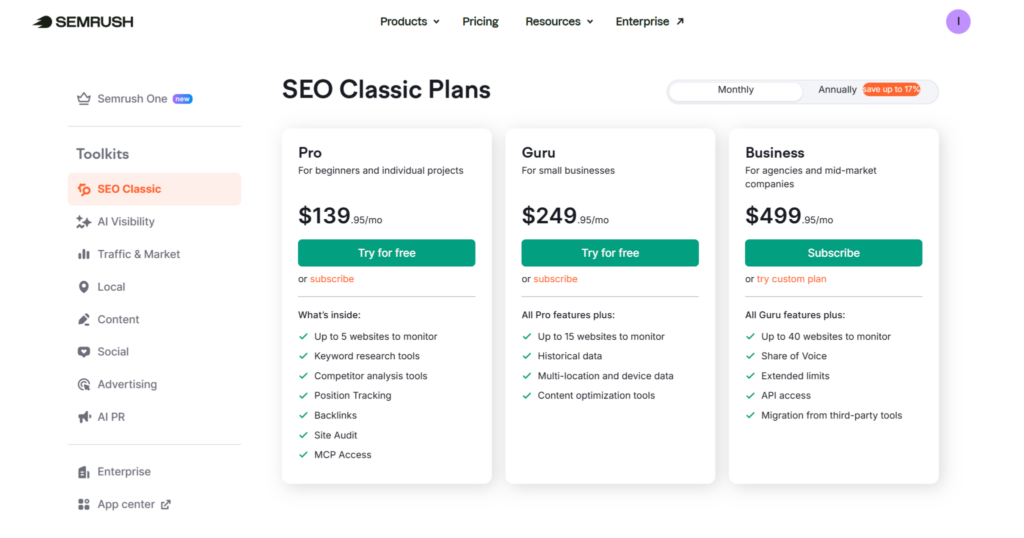
Semrush API is the best SEO API for agencies already inside the Semrush ecosystem that need clickstream data. Semrush forces users to purchase their expensive Business tier before unlocking the ability to buy specific unit packages. Marketers pull deep clickstream trends and precise local listing rankings via standard CSV exports. The network runs specific technical audits to check if pages are visible to generative chatbots. It gets expensive fast.
What Are the Key Features of SEMrush API?
- Multi-Toolkit Architecture: The system separates endpoints into distinct modules. Analytics, Projects, Trends, and Local modules require different query structures.
- AI Search Health Audit: This specialized audit scores your website readiness for generative crawlers. It verifies structured data, checks llms.txt configurations, and finds technical blockers.
- Deep Clickstream Trends: The Trends API pulls raw clickstream data. You can evaluate domain performance across massive global industries.
- Customizable Column Export: You pass specific export_columns parameters in your GET request. This forces the server to return only the requested CSV columns, reducing payload size.
- OAuth 2.0 Security: The Projects module utilizes OAuth 2.0 authentication. This allows secure, temporary access tokens for third-party client integrations.
- Granular URL Extraction: You can pull analytics specifically for subfolders or subdomains without querying the entire root domain.
- Local Listings Management: Specific endpoints handle Google Maps ranking data and maintain consistent business information across location directories.
What Are the Pros and Cons of SEMrush API?
Pros:
- This is a well-known best SEO API for marketers already embedded in the Semrush ecosystem.
- It functions as a reliable best SEO data API for clickstream and traffic estimations.
- Agencies call it the best API for SEO because they can build custom client portals quickly.
- The search engine rankings API provides deep historical data reaching back years.
- Reliable SEO API integration uses standard CSV formatting which imports directly into Excel natively.
- Large best SEO API providers rarely offer generative health scores. Their AI Search Health Audit stands out.
- Other SEO data API providers guess at traffic. Semrush uses proprietary panels for accuracy.
Cons:
- Running complex SEO API automation is hard because of severe rate limits. You can’t exceed 10 inquiries per second.
- An external SEO analyzer API will fail if it launches more than 10 simultaneous connections from one user.
- The initial SEO integration API setup costs at least $499.95 per month just to access the Business tier.
- Extracting heavy SEO stats API rows drains your balance. A single backlink call costs 40 API units per line.
- The SEO optimization API forces you into a rigid credit system. Unused API units expire at the end of the month completely.
- It acts as an expensive SEO tool API. You buy packages of 2 million units, and they vanish if your traffic drops.
- Building a profitable SEO API tool is hard when your base server costs start so high.
- The SEO tools API documentation is somewhat fragmented across different modules.
- Deploying fast API SEO tools requires caching the CSVs locally to avoid repeating expensive calls.
What Is the Pricing of SEMrush API?
- Business Tier Requirement: The Standard API is exclusively available as an add-on to the Business subscription. This plan costs $499.95 per month.
- Zero Initial Balance: Paying $499.95 only unlocks the opportunity to buy access. The initial API unit balance is strictly zero.
- Unit Package Blocks: You must purchase units in scalable blocks. Packages come in 2 million, 5 million, 10 million, and 20 million increments.
- Aggressive Unit Consumption: Every single request burns units. Fetching backlink data costs 40 units for every single line of data returned.
- Expiration Without Rollover: All purchased units renew on the same day as your core subscription. Unused units expire immediately. They never roll over.
- Balance Monitoring: Checking your unit balance requires logging into the Subscription Info tab or executing a specific free query.
5. Bishopi API

Bishopi is the best SEO API for domain investors who want cheap access to expired-domain and backlink metrics. Bishopi serves domain investors needing affordable access to dropped site metrics. You buy monthly credit packages starting at twenty-nine dollars. The platform supplies real-time SERP extraction alongside a massive 6.4 trillion link database. This avoids forcing enterprise contracts on smaller freelance teams.
What Are the Key Features of Bishopi API?
- Expired Domain Intelligence: The platform tracks domain valuations, historical sales data, and fresh drops globally. Investors use this to snatch expiring assets.
- Massive Link Database: The backlinks module queries an index containing 6.4 trillion links. It calculates dofollow ratios and tracks discovery dates.
- Historical Traffic Analysis: The traffic endpoints reveal visitor behavior, geographic routing data, and conversion metrics across desktop and mobile devices.
- Keyword Competitor Gap: The system calculates difficulty scores and CPC metrics. You can run competitor gap analysis directly through the endpoints.
- Dual Mode Processing: The infrastructure supports both Live and Asynchronous engines depending on the requested payload size.
- Trust Flow Metrics: The domain analysis tools return instant authority insights and trust flow benchmarks against competitors.
- Automated Age Checkers: Basic utilities like WHOIS lookups and domain age verification run quickly.
What Are the Pros and Cons of Bishopi API?
Pros:
- For domain investors, this is one of the best SEO API options on the market.
- It operates as an affordable best SEO data API compared to the giant legacy networks.
- Freelancers consider it the best API for SEO when dealing with expired link graphs.
- The search engine rankings API costs pennies compared to Ahrefs.
- You get fast SEO API integration using their documented Python SDKs.
- Most generic best SEO API providers ignore domain drop lists completely.
- Niche SEO data API providers rarely offer 6.4 trillion backlinks. This is substantial.
Cons:
- Building deep SEO API automation for enterprise brands fails because the keyword index is smaller than Semrush.
- An enterprise SEO analyzer API requires massive geographic coverage. Bishopi focuses heavily on Google US.
- Fast SEO integration API architecture requires GraphQL in modern stacks, but they rely heavily on standard REST.
- Extracting ten-year SEO stats API data is impossible for obscure niches.
- The SEO optimization API lacks native LLM prompt tracking features entirely.
- It functions well as a niche SEO tool API, but agencies need broader toolsets.
- Your custom SEO API tool might encounter timeouts when querying massive dropped domain lists simultaneously.
- The core SEO tools API provides 2,500 credits for $29. This is cheap, but heavy processing burns it fast.
- Building large API SEO tools on this network requires you to upgrade to the $249 Enterprise tier quickly.
What is the Pricing of Bishopi API?
- Tiered Credit Structure: The pricing relies on a monthly subscription that dispenses an exact credit allotment.
- Starter Plan Economics: The basic Starter tier costs $29 per month. It grants 2,500 credits. This calculates to roughly $0.0092 per single credit.
- Growth Plan Capacity: The Growth tier costs $49 per month. It dispenses 5,000 credits. This drops the cost to $0.0078 per credit.
- Professional Allowances: Serious developers pay $129 per month. They receive 15,000 credits. This tier unlocks the full site audit capabilities.
- Annual Discounts: Paying for an entire year upfront slashes the monthly cost by exactly 20 percent.
- Free Trial Access: New accounts receive a 7-day free trial. They give you 500 initial credits to test the REST endpoints. No credit card is required.
Which SEO API Should You Choose?
Choose your SEO API by use case, not by brand name. Each provider wins a specific scenario and loses badly outside it. Match the tool to your build, your budget, and your data volume.
| If you… | Best pick | Why |
|---|---|---|
| Want standalone data plus AI-agent access | SE Ranking | Native MCP server, no full dashboard subscription required |
| Need the deepest enterprise backlink index | Ahrefs | Largest commercial link database, five-year history |
| Building a headless app or agency dashboard | DataForSEO | Pure pay-as-you-go, no UI to pay for |
| Already inside the Semrush ecosystem | Semrush | Clickstream accuracy and CSV exports for client portals |
| Investing in expired or dropped domains | Bishopi | Cheap credits and a 6.4 trillion link index |
Want to test before you commit? Compare the entry points first.
| Platform | Free trial | Entry price |
|---|---|---|
| SE Ranking | 14 days, 100,000 credits | $318.00/mo (annual, standalone) |
| Ahrefs | Free test queries only | $1,499.00/mo (Enterprise) |
| DataForSEO | No trial, $50 min deposit | $50.00 deposit (pay-as-you-go) |
| Semrush | No API trial | $499.95/mo (Business + units) |
| Bishopi | 7 days, 500 credits, no card | $29.00/mo (Starter) |
So what does this mean for you? If you build AI workflows, SE Ranking wins on the MCP server. If backlinks are everything and budget isn’t a concern, Ahrefs leads. If you want to pay per call with zero overhead, DataForSEO fits. The rest comes down to which ecosystem you already live in.
Where Does Analytify Fit Once SEO Traffic Lands on Your Site?
Analytify shows you what visitors do after they arrive, presenting your Google Analytics 4 data directly inside the WordPress dashboard. It’s not an SEO data API and doesn’t replace one. The five platforms above pull rankings, keyword volumes, and backlink graphs. Analytify covers the step that comes next: measuring on-site behavior.
A keyword ranking API tells you which keywords you rank for and your position in the SERPs. It can’t tell you whether that traffic converts, which posts hold attention, or where buyers drop off. That answer lives in your analytics, not in a SERP endpoint.

Here’s what Analytify adds once the click becomes a visit:
- Inside WordPress: Analytify presents GA4 sessions, pageviews, and events without making you leave your dashboard or open a separate analytics tab.
- Per-post reporting feature: Analytify displays traffic for each post directly below it in the WordPress editor, so you can see which SEO-targeted pages actually earn views.
- eCommerce visibility: Analytify tracks WooCommerce revenue, transactions, and top products inside the dashboard, connecting rankings to real sales.
- Deeper reports (Pro): Analytify Pro adds author, campaign, real-time, and form-conversion reports. These reports are Pro-only, not part of the free tier.


If you are already paying for an SEO API to win rankings, the missing half is knowing what that traffic does once it arrives. Analytify closes that gap inside WordPress.
Join 50,000+ WordPress users who use Analytify to see their Google Analytics without the complexity. Get Analytify and connect the on-site half of your data picture.
Frequently Asked Questions
1. How Do Rate Limits Affect Data Extraction?
Rate limits restrict the absolute number of HTTP requests a server accepts within a specific timeframe. Exceeding these limits triggers HTTP 429 status codes. Your application must implement exponential backoff algorithms to pause execution momentarily. Semrush restricts simultaneous connections to ten per user. Ahrefs limits total queries to sixty per minute.
2. What is the Difference Between Synchronous and Asynchronous Endpoints?
Synchronous requests block your client code until the remote server returns the final data payload. This works well for fast, cached databases. Asynchronous requests return a job identifier immediately. The vendor server processes the heavy extraction in the background. The client must either poll a secondary GET endpoint or listen for an automated webhook.
3. Why Do Vendors Use Credit Systems Instead of Flat Billing?
Different database operations consume varying amounts of server CPU and proxy bandwidth. Scraping a real-time mobile map requires significantly more resources than querying a static keyword database. Credits standardize the underlying computational cost. Complex generative LLM queries deduct thousands of credits. Simple cached lookups deduct one credit.
4. Can Generative Search Visibility Be Tracked Programmatically?
Yes. Modern data vendors deploy automated agents to query language models directly. They extract the exact text responses and parse the hidden citation links. This data is structured into JSON formats. Developers then filter the payloads to track specific brand mentions across ChatGPT, Claude, and Gemini.
5. What Are the Standard Authentication Methods for These Services?
Most platforms use Bearer tokens passed directly within the HTTP Authorization header. This prevents secret keys from logging in plain-text URLs. Some systems still support legacy API keys passed as query parameters. Enterprise platforms like Semrush mandate OAuth 2.0 protocols. OAuth issues temporary access tokens to secure multi-user environments safely.
6. Can an SEO API Show What Visitors Do after They Land on Your Site?
No. SEO APIs return rankings, keyword volumes, and backlink data, not on-site behavior. To see sessions, conversions, and per-post engagement, you need a Google Analytics layer such as Analytify, which displays GA4 data inside the WordPress dashboard. Pair the two: an SEO API to win the click, and Analytify to measure what happens after it.
The Best SEO API: Bottom Line
The best SEO API is the one whose billing model matches your build. Technical procurement demands strict cost math and continuous latency testing. Pay-as-you-go frameworks accommodate independent developers well. Enterprise tiers serve large corporate dashboards. Inspecting JSON payload structures upfront prevents downstream parsing failures.
Three quick steps before you commit:
- Match the billing model to your build: pay-as-you-go for headless tools, subscription add-ons for dashboards, standalone credits for AI-agent workflows.
- Run a latency test on your highest-volume endpoint before signing any annual contract.
- Connect the on-site half of the picture, so you can see what the traffic you win actually does.
See exactly what your hard-won SEO traffic does inside WordPress: start with Analytify.
Further Readings: