Conversion Intelligence: Using Analytify to Improve AI-Generated Funnels

Ever wondered why some users leave your AI-generated pages without converting, even when traffic, load speed, and design all appear optimized? That’s where conversion intelligence analytics comes in.
AI can build funnels at scale, but it cannot judge funnel quality without analytics. Speed and automation mean nothing if you don’t understand how users actually move through the funnel.
Unlike basic tracking, which only shows whether someone converted, conversion intelligence reveals how, why, and where conversions happen. It follows users’ complete journey across pages, events, and interactions.
With these insights, teams can track AI-generated landing pages, identify which pages perform best, and accurately measure funnel drop-offs.
In this guide, we explain how conversion intelligence works and compare it with traditional tracking. We also highlight common AI funnel challenges and show how Analytify helps teams interpret GA4 data, optimize AI funnels, and improve conversions step by step.
Let’s get started!
Conversion Intelligence Analytics (TOC):
What is Conversion Intelligence and Why AI Funnels Need It
Conversion intelligence is an advanced approach to analyzing user behavior that focuses on understanding how, why, and where conversions occur, not just counting them.
Instead of only tracking completed actions, conversion intelligence analytics look at the full journey users take across pages, events, and interactions. This approach helps businesses see where users struggle before converting or dropping off.
When comparing conversion intelligence vs basic conversion tracking, the difference is clear.
Let’s see it in the table below:
| Aspect | Basic Conversion Tracking | Conversion Intelligence |
| Focus | Confirms if a conversion happened | Explains how and why it happened |
| Data tracked | Final action only | Complete user journey and behavior |
| Main question | “Did the user convert?” | “Why did the user convert or drop off?” |
| Funnel insight | Limited to start and end | Step-by-step funnel understanding |
| Drop-off analysis | Shows where users left | Explains why users left |
| Optimization value | Reporting only | Actionable insights for improvement |
| Suitability for AI | Limited for AI analysis | Ideal for AI funnel optimization |
Conversion intelligence analytics closes this gap by looking at how users interact with each step of the funnel. It analyzes users’ behavior, engagement, and timing to highlight issues such as confusing content, poor page order, or unexpected friction.
This level of detail is essential for AI-generated funnels. AI depends on path-level data to judge funnel quality. Without visibility into user paths, AI optimizes content blindly, repeating patterns that look good on the surface but fail to convert.
By analyzing the full-funnel journey rather than just the final click, conversion intelligence helps both AI systems and teams make better optimization decisions based on real user behavior.
Common Problems With AI Funnels and the GA4 Challenge
Conversion intelligence analytics can address these issues by examining two areas separately: the challenges of AI-generated funnels and the difficulties GA4 presents when auditing them.
1. Common Problems With AI Funnels
AI funnels face several issues that can reduce conversion effectiveness:
- High traffic, low progression: Even with strong traffic, users may not move smoothly through the funnel due to friction points or confusing content.
- Competing AI pages: Multiple AI-generated variations can create conflicts, making it difficult to know which page performs best.
- Missing micro-conversion signals: Small actions such as clicks, scroll depth, or engagement with page elements often influence conversions but may go untracked.
- Inconsistent data across touchpoints: AI funnels often involve various pages, forms, or tools. Without consistent tracking, insights into user behavior become fragmented, reducing the effectiveness of AI optimization.
2. Why GA4 Makes Funnel Audits Hard
While GA4 provides detailed tracking, it has limitations that complicate AI funnel analysis:
- Explorations setup friction: GA4 Explorations require careful configuration to track complete user journeys.
- Path reports are analyst-focused: GA4 path reports are designed for technical users, making it hard for marketing or product teams to interpret.
- Hard to share insights with non-technical teams: Complex dashboards and reports make communication and action slower.
- Default tracking gaps: Without custom events, GA4 may miss interactions on AI-generated landing pages, limiting visibility into drop-offs and micro-conversions.
Understanding AI funnel challenges and GA4 limitations helps businesses identify where tracking and optimization fall short.
Conversion intelligence analytics then provides the insights needed to track AI-generated landing pages, measure funnel drop-offs, and improve overall performance.
How Analytify Enables Conversion Intelligence Analytics
Join 50,000+ beginners & professionals who use Analytify to simplify their Google Analytics!
Analytify is a Google Analytics plugin that integrates seamlessly with GA4, eliminating the need for complicated setups or extra tracking tools.
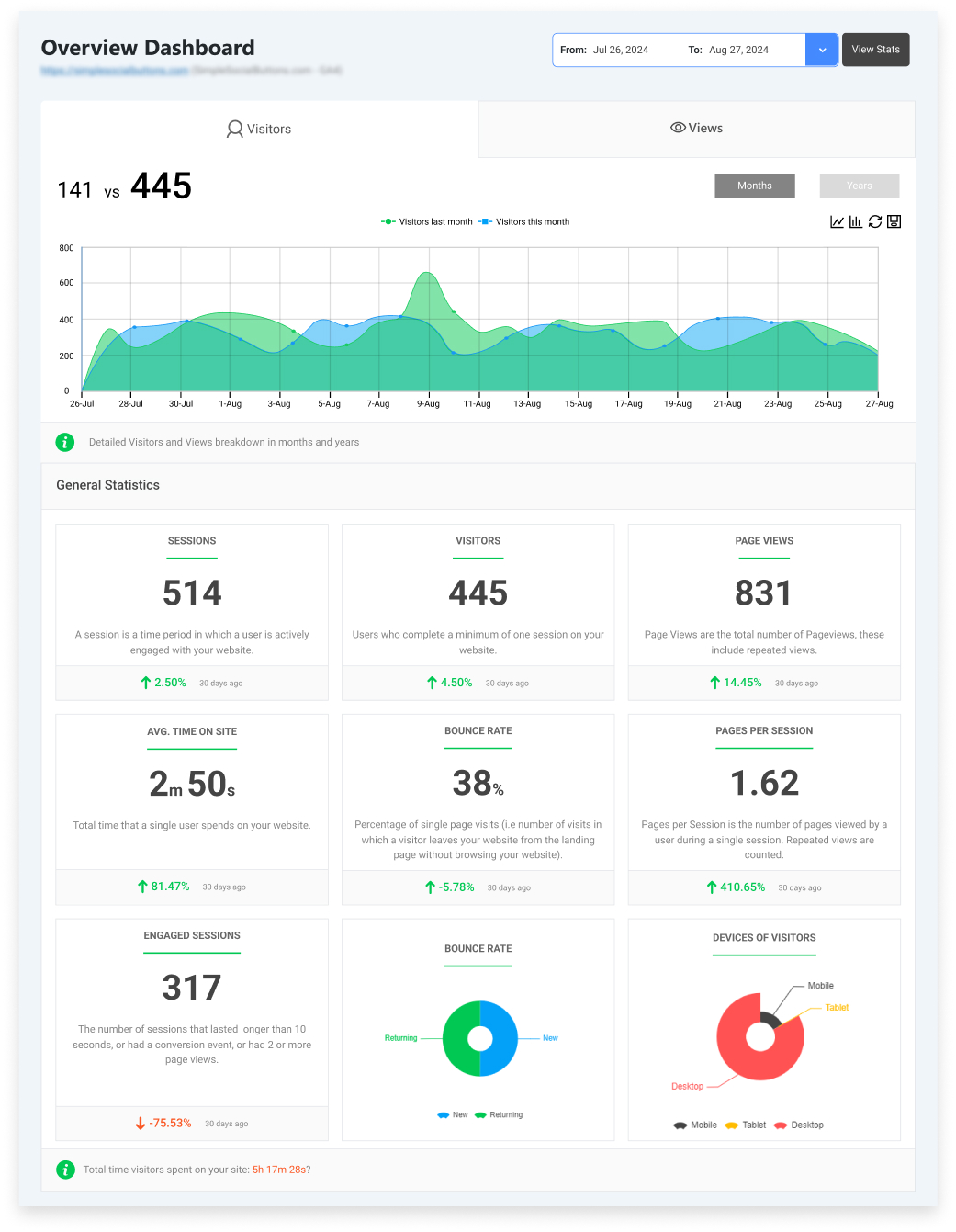
Unlike standard GA4 dashboards, which often present raw data in complex charts, Analytify transforms GA4 data into actionable, conversion-focused insights, making it easier to understand real user behavior across AI-generated funnels.
Analytify highlights page engagement vs conversions and goal contribution by page, showing exactly which pages help users move forward and which create friction.
This allows teams to clearly measure funnel drop-offs, identify weak points, and optimize the AI funnel based on real behavior rather than assumptions.
Why Analytify Is Well-Suited for AI Funnel Analysis
- AI-generated funnels often produce multiple landing pages, making it challenging to track individual page performance in GA4.
- Analytify’s page-centric analytics shows how users interact with each page and how pages connect within the broader funnel.
- Analytify presents insights in a human-readable format, using clear reports instead of complex charts.
- This makes it easy for teams to review data, test ideas, and continuously improve AI funnel optimization based on real results.
- Because reports are updated quickly, Analytify also provides faster feedback for AI-driven experiments. Teams can see what’s working, adjust strategies in real time, and continuously improve funnel performance.
Tracking AI-Generated Landing Pages With Analytify
Tracking AI-generated landing pages becomes much easier when you use Analytify as part of your conversion intelligence analytics.
The first step is identifying which pages are created by AI. This can be done using simple signals like URL patterns, page titles, campaign parameters, or UTM tags.
When AI pages follow a clear naming structure, they are easier to group, track, and analyze over time.
Once identified, Analytify’s Pages report helps you isolate these AI pages without having to dig into complex GA4 menus. You can view how each page performs and understand its role in the funnel.
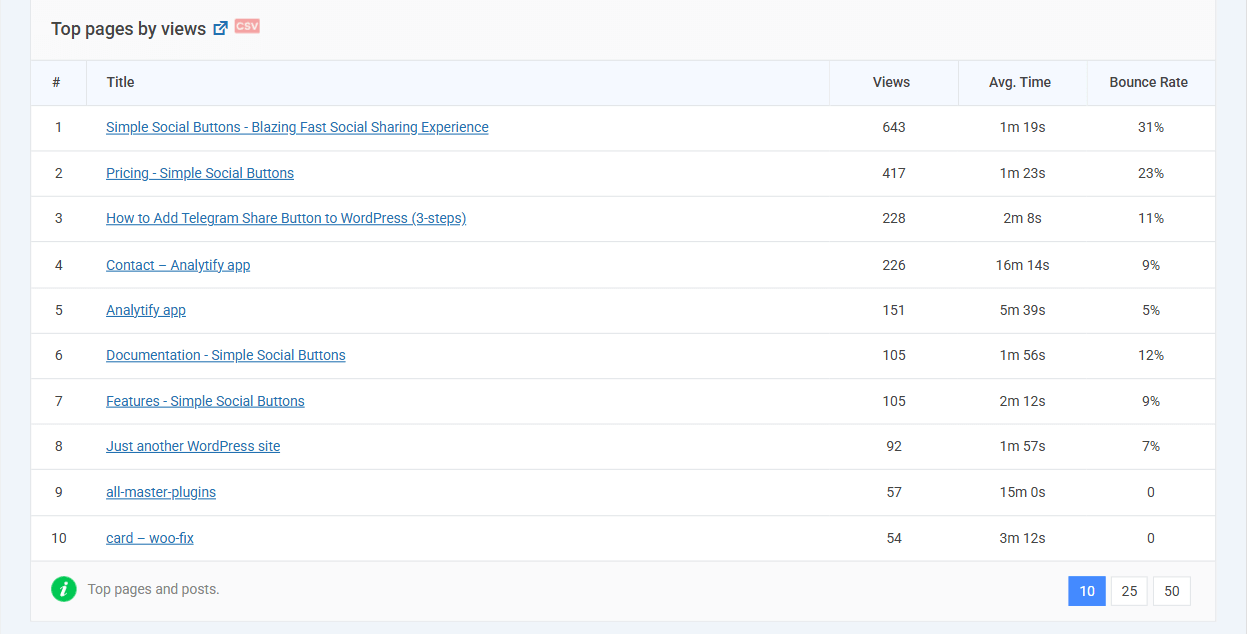
To understand performance clearly, focus on a few key metrics.
- Page views vs. engaged sessions: see whether users are interacting or leaving quickly.
- Bounce rate and average engagement time: reveal early signs of confusion or lack of interest.
- Conversion contribution: shows whether a page helps users move forward or creates friction, making funnel drop-offs easier to measure.
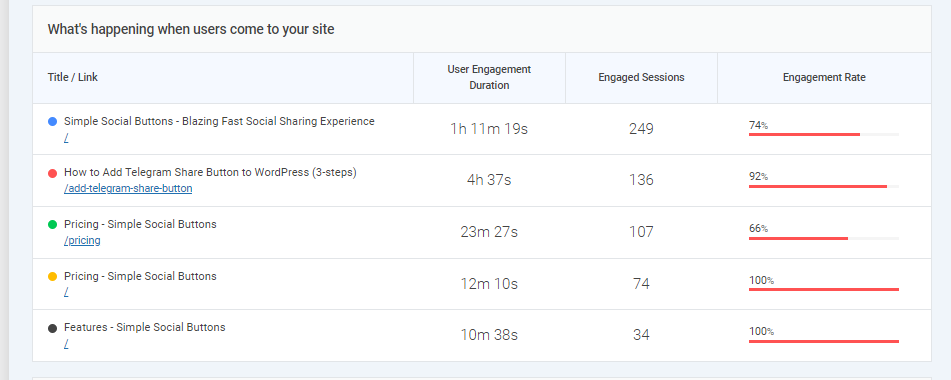
Analytify also allows you to compare AI-generated pages with human-written ones, highlighting underperforming AI pages early. This lets teams refine content, improve flow, and optimize the AI funnel efficiently.
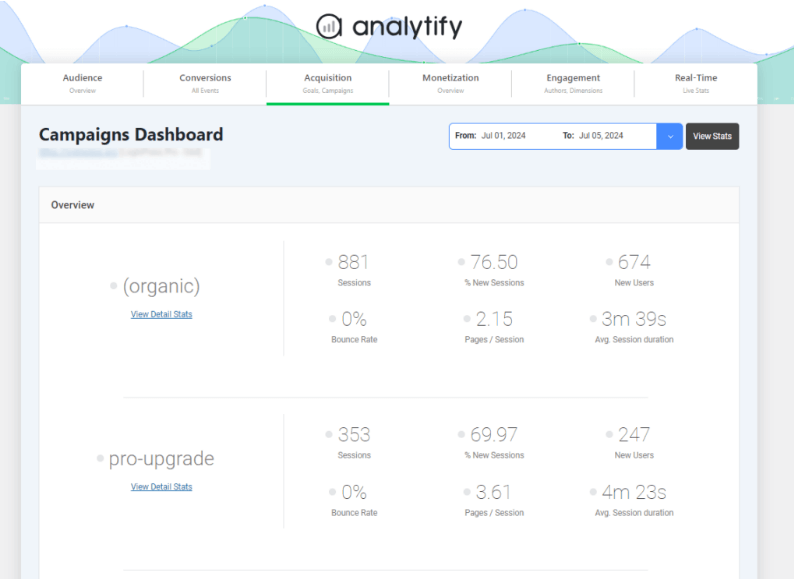
Additionally, UTM campaign tracking add-ons can be used to monitor traffic sources, campaigns, and variations in AI page performance, helping you measure which campaigns drive the most engaged users.
Visualizing Conversion Paths to Optimize AI Funnels
AI funnels rarely move in a straight line. Users may skip steps, revisit pages, or leave earlier than expected. This is why simple, linear funnel thinking often fails.
To improve AI funnels, teams first need a clear picture of how users actually behave across pages.
Analytify helps build this understanding by combining page-level insights, event data, and overall site statistics. It provides the building blocks needed to understand user movement, such as which pages users enter from, which pages keep them engaged, and which ones lead to conversions.
Key signals include:
- High exits after engagement: users interact with content but leave without converting.
- Engagement without next-step events: users stay on pages but fail to take the intended action.
- Inconsistent conversion activity: some pages contribute to conversions while others stall progress.
These signals reveal issues such as unclear AI content, poor page layout, or a mismatched user intent. By systematically measuring funnel drop-offs, teams can see exactly where users leave or fail to progress and why.
Using campaign and event tracking add-ons, along with page reports and general stats, helps teams measure funnel drop-offs more clearly and accurately.
Because AI funnels change quickly, taking action without validation can lead to mistakes. Analytify helps teams validate updates before scaling, ensuring optimization is based on real user behavior rather than assumptions.
The real value comes from turning these insights into action. Teams can rewrite AI copy, redesign pages, adjust funnel order, or remove low-intent AI-generated pages to improve overall funnel performance.
Improving AI Funnel Optimization With Conversion Intelligence
Here’s how conversion intelligence helps improve AI funnel optimization:
1. Using Data to Guide AI Content
- Conversion intelligence analytics show which pages, messages, and steps actually lead to conversions.
- These insights can be fed back into AI prompts, so AI generates content that aligns with proven conversion paths rather than random ideas.
2. Simple Optimization Loop
- First, you measure funnel drop-offs to see where users leave.
- Next, AI refines content or page flow based on that data.
- Then, you validate the changes by checking if conversions improve.
- This loop works without a heavy GA4 setup, making optimization easier for non-experts.
3. Scaling Funnels Without Losing Quality
- As AI creates more funnels or pages, quality can drop if there’s no feedback.
- Conversion intelligence helps track AI-generated landing pages and spot which ones perform well.
- This allows you to scale funnels while maintaining high conversion quality.
4. Avoiding Too Many Low-Performing Pages
- AI can quickly create many pages, but not all of them work.
- Conversion intelligence analytics highlight weak pages early.
- Teams can pause, fix, or remove poor-performing content instead of wasting time and budget.
5. Better Team Collaboration With Clear Insights
- Tools like Analytify turn conversion intelligence analytics into easy-to-understand visual reports.
- These insights can be shared across SEO, CRO, content, and product teams, keeping everyone on the same page and helping them understand funnel performance.
- Everyone works from the same data, reducing confusion and misalignment.
6. Less Dependence on GA4 Specialists
- Conversion intelligence tools simplify complex data into clear insights.
- Teams don’t need to rely heavily on GA4 experts for every decision.
- Faster understanding leads to faster improvements.
Conversion intelligence analytics help AI funnels learn from real users, improve step by step, and grow without losing focus on what truly drives conversions.
Common Mistakes When Analyzing AI Funnels (And How Analytify Helps Avoid Them)
Here are the most common mistakes in analyzing AI funnels and how Analytify helps teams avoid them.
- Relying Only on Conversion Rate
Looking only at the final conversion number hides what users did before converting. Analytify reveals user journeys, showing the actions that lead to conversions.
- Not Understanding Why Users Drop Off
Knowing where users leave isn’t enough; guessing reasons can lead to wrong changes. Analytify tracks behavior and engagement metrics to reveal why users drop off.
- Ignoring Assisted Conversions
Focusing only on the final conversion undervalues the pages that contributed along the way. Analytify highlights multi-step interactions and assisted conversions.
- Treating AI Pages as Isolated Assets
Analyzing pages separately breaks the funnel view and limits optimization. Analytify provides a unified view connecting all AI-generated pages.
- Making Changes Without Validating Drop-Offs
Updating content blindly can worsen funnel performance. Analytify offers real-time funnel analytics to validate drop-offs before changes.
- Overproducing AI Pages Too Quickly
Creating many pages without tracking quality leads to clutter and weak performance. Analytify monitors individual page performance to prioritize high-impact pages.
- Ignoring User Engagement Signals
Skipping metrics like clicks, scroll depth, or time on page misses early signs of friction or interest. Analytify tracks engagement signals to provide deeper insights.
- Keeping Insights Limited to One Team
Limited data sharing slows improvements and reduces impact. Analytify generates automated, shareable reports for all teams.
FAQs: Conversion Intelligence Analytics
1. What is conversion intelligence analytics?
Conversion intelligence analytics is a way to understand not just whether users convert, but why and how they do it. It examines the full visitor journeys, tracking behavior, engagement, and interactions to reveal friction points. Using this approach helps improve AI funnel optimization by showing exactly which steps or pages guide users toward conversion.
2. How do I audit my funnel with Google Analytics?
Auditing a funnel in Google Analytics usually involves checking each step of the conversion path to see where users drop off. You can track metrics like page visits, clicks, and goal completions. However, GA alone often misses the deeper why, which is where conversion intelligence analytics can help by analyzing patterns and user behavior across the entire funnel.
3. Can I track AI-generated landing pages in GA4?
Yes, GA4 can track AI-generated landing pages, but it can get complicated if you have many pages or dynamic variations. Using tools that integrate conversion intelligence analytics makes it easier to track AI-generated landing pages, measure performance, and understand how each page contributes to the overall funnel.
4. How do I measure funnel drop-offs without GA4 Explorations?
You can measure funnel drop-offs using platforms like Analytify, which simplify the process. They provide step-by-step insights into where users leave the funnel, highlight friction points, and allow you to track AI-generated landing pages without setting up complex GA4 Explorations. This helps teams optimize AI funnels faster.
5. Is Analytify suitable for AI-driven CRO workflows?
Yes, Analytify works well for AI-driven CRO workflows because it turns complex analytics into simple, visual reports. Teams can collaborate, track AI-generated landing pages, measure funnel drop-offs, and use conversion intelligence analytics to make informed changes that improve AI funnel optimization.
Final Thoughts: Conversion Intelligence Analytics
We started by understanding what conversion intelligence analytics is and why AI funnels need it to see not just if users convert, but why and how they do.
Then we compared it with basic conversion tracking to show the value of analyzing the full user journey. Next, we explored common AI funnel challenges and how conversion intelligence analytics helps solve them.
We saw how Analytify enables conversion intelligence analytics by simplifying GA4 data, providing page-level insights, and helping teams effectively track AI-generated landing pages.
This supports AI funnel optimization, gives human-readable reports, and provides faster feedback for experiments.
Finally, we discussed improving AI funnel optimization and enhancing team collaboration. We highlighted common mistakes and how Analytify helps teams avoid them.
For further guidance, you can read:
- How to Build AI-Optimized Reports Using Analytify (for Teams & Clients)
- AI Content Creation Strategies & Tools You Should Use in 2026
What part of your AI funnel do you think needs the most improvement right now? Share your thoughts in the comments below. We’d love to hear how you’re optimizing your funnels!