

13 Most Important Google Ranking Factors in 2026 (Complete Guide)

Google ranking factors are the signals Google’s algorithm uses to determine where every page lands in search results.
Google’s ranking factors and algorithm changed more between 2023 and 2026 than in the previous five years combined. AI Overviews now appear on over 40% of US searches. INP replaced FID as a Core Web Vitals metric in March 2024. FAQ rich results were deprecated in May 2026. Topical authority now outweighs individual page quality in competitive SERPs.
Each of these shifts in Google ranking factors requires a different response. Ignoring any one of them costs rankings on the next core update.
In this guide, you’ll learn the top Google ranking factors that matter in 2026: what each signal does, how much it has changed, which ones now determine your visibility inside AI-generated answers as well as traditional search results, and the exact order to prioritize them if you want to move rankings in weeks rather than months.
Google Ranking Factors (TOC):
What Are Google Ranking Factors?
Google ranking factors are the signals Google’s algorithm uses to decide which pages appear at the top of search results for a given query. Google evaluates hundreds of Google ranking factors simultaneously, from how fast your page loads to whether the author has genuine, first-hand expertise on the topic.
The scale of Google Search makes these ranking factors critical. Google processes approximately 16 billion searches every day, which is why its Google ranking factors affect virtually every business online, roughly 5.9 million per minute, and holds over 91% of the global search engine market share. Ranking well is not optional for any content-driven business.
The stakes are brutal. According to Ahrefs’ large-scale study of 1 billion web pages, 96.55% of all pages receive zero organic traffic from Google. They fail to meet the minimum threshold across Google ranking factors. The difference between the invisible majority and the top-performing minority almost always traces back to the ranking factors in this guide.
Google Ranking factors 2026 fall into five categories:
- Content signals: quality, relevance, E-E-A-T, topical depth
- Technical signals: Core Web Vitals, crawlability, site speed, security
- Authority signals: backlinks, brand mentions, topical authority
- User experience signals: engagement, dwell time, mobile usability
- AI search signals: structure, extractability, schema, GEO optimization
That is Infographic 1. Placement note for the article: insert it right after the 5-bullet category list at the end of the “What Are Google Ranking Factors?” section with this caption:
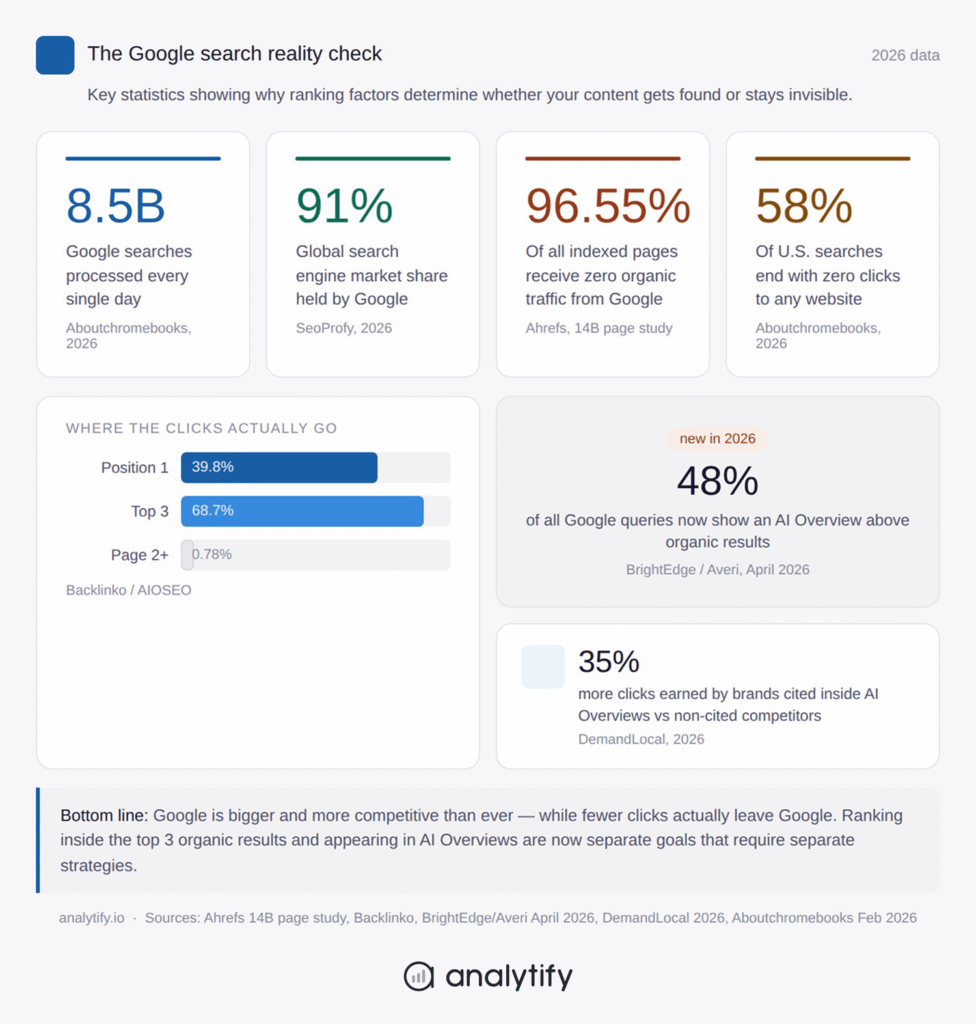
How Did Google Ranking Algorithm Change in 2026?
Google’s ranking factors in 2026 look fundamentally different from those in 2022. 4 structural shifts changed everything:
1. The Helpful Content era is permanent. Google’s Helpful Content System, introduced in 2022 and expanded through multiple core updates, now runs as a continuous sitewide Google ranking factor. Low-quality or thin content anywhere on your site can suppress well-optimized pages, it is one of the most damaging Google ranking factors to get wrong.
2. AI Overviews changed where clicks go. Over 40% of US Google searches now trigger an AI Overview, according to Similarweb’s 2026 Generative AI Landscape report. Brands cited inside an AI Overview earn 35% more organic clicks than brands that are not cited, according to a Seer Interactive study of 3,119 informational queries. Zero-click searches are also common: 58.5% of US Google searches in 2024 ended without a click, according to SparkToro and Datos.
3. E-E-A-T is now algorithmically measurable. Experience, Expertise, Authoritativeness, and Trustworthiness are no longer just quality rater guidelines. Google can now detect author credentials, first-hand experience signals, and real-world authority (all measurable Google ranking factors) at a technical level and acts on them at scale.
4. Google Discover now runs on a separate ranking algorithm and set of ranking factors from Search.
Google’s February 2026 Discover Core Update is the first core update issued exclusively for Discover. It does not affect organic Search rankings. It changes which Google ranking factors determine how content is selected and ranked inside the Discover feed.
The core change: engagement metrics (CTR, dwell time) no longer determine Discover eligibility. E-E-A-T signals now function as a quality gate first. Sites built on clickbait saw Discover traffic drop 30 to 60 percent. Sites with consistent topical depth and original content gained visibility by aligning with these Google ranking factors.
Topical authority is now the primary Discover Google ranking factor. Consistent publishing within one niche outperforms chasing trending topics across unrelated categories.
The ranking factors Discover rewards after this update (E-E-A-T, topical depth, original content) are the same Google ranking factors that determine your Search rankings. Improving one channel improves the other.
These 4 shifts in Google ranking factors mean content that ranked well in 2021 may actively underperform today, even with no changes to the page itself.

The 13 Most Important Google Ranking Factors in 2026
| # | Ranking Factor | Impact Level | Changed Since 2023? |
|---|---|---|---|
| 1 | E-E-A-T and Content Quality | Critical | Yes: stronger sitewide enforcement |
| 2 | Core Web Vitals and Page Speed | Critical | Yes: INP replaced FID in March 2024 |
| 3 | Search Intent Match | Critical | Yes: more nuanced intent detection |
| 4 | Topical Authority | High | Yes: cluster-based ranking rewarded |
| 5 | Backlinks and Link Authority | High | Same: quality over quantity enforced |
| 6 | Mobile-First Indexing | High | Same: fully enforced since 2024 |
| 7 | On-Page Keyword Optimization | High | Same: semantic context matters more |
| 8 | Technical SEO and Site Structure | High | Same |
| 9 | HTTPS and Website Security | Medium | Same |
| 10 | User Experience Signals | High | Yes: RankBrain + Gemini models |
| 11 | Structured Data and Schema | Medium-High | Yes: FAQ rich results deprecated May 2026 |
| 12 | Internal Linking | Medium | Same |
| 13 | AI Search Optimization (GEO) | Emerging-Critical | New category for 2026 |
1. E-E-A-T and Content Quality
E-E-A-T (Experience, Expertise, Authoritativeness, Trustworthiness) is Google’s primary content quality framework and the single strongest on-page Google ranking factor in 2026. Google added “Experience” to the original E-A-T framework in December 2022, making E-E-A-T one of the most impactful Google ranking factors, fundamentally changing what high-quality content means.
The “Experience” addition matters most. Google now rewards content written by people who have actually done the thing they are writing about. Experience is one of the core Google ranking factors. A plugin tutorial from someone who installed and configured the tool will outrank a paraphrased guide from someone who never touched it, even if both pages have similar keywords and backlinks.
Content age and freshness both play a role. Approximately 73% of the pages ranking in Google’s top 10 are more than 3 years old (demonstrating how time-tested Google ranking factors compound) meaning they have had time to accumulate engagement, editorial reviews, and earned authority. But freshness is also among the key Google ranking factors for AI citation specifically: content under 3 months old is 3x more likely to be cited in AI answers than older, unrefreshed content. The practical answer: build content that earns authority over time by mastering each Google ranking factor, but update it quarterly.
What E-E-A-T requires in practice:
- Author bylines with verifiable credentials, a publication history, or a detailed About page
- First-hand examples, screenshots, or data from real use of the product or tool
- Cited sources from authoritative external domains (.gov, .edu, official product documentation)
- No thin content, no AI-generated pages without editorial oversight and accuracy review
- Accurate, current information with a visible “Last Updated” date on every article
- Quarterly content updates are a key Google ranking factor because AI citation decay begins at 13 weeks without an update
E-E-A-T is a sitewide Google ranking factor. One cluster of low-quality pages can lower the trust score for your entire domain (E-E-A-T operates as one of the most important sitewide Google ranking factors) pulling down even your best-performing content.
2. Core Web Vitals and Page Speed
Core Web Vitals are Google’s official page experience metrics and a confirmed Google ranking factor since May 2020. In March 2024, Google replaced First Input Delay (FID) with Interaction to Next Paint (INP) as the interactivity metric, the biggest change to Core Web Vitals since their introduction.
The three current Core Web Vitals are:
| Metric | What It Measures | Good Score | Needs Improvement |
|---|---|---|---|
| LCP (Largest Contentful Paint) | How fast the main content loads | Under 2.5s | 2.5s to 4.0s |
| INP (Interaction to Next Paint) | How fast the page responds to clicks/taps | Under 200ms | 200ms to 500ms |
| CLS (Cumulative Layout Shift) | How stable the layout is while loading | Under 0.1 | 0.1 to 0.25 |
Only 33% of websites currently meet Google’s Core Web Vitals standards. Simply passing all three thresholds puts you ahead of two-thirds of the web on page experience alone.
Page speed affects visitor behavior before Google ranking algorithm gets involved. Research cited by Google and Deloitte has consistently shown that slow pages drive users away. Page speed is among the top Google ranking factors, before the content even loads. This is a negative UX signal and a real set of Google ranking factors that compound into lower rankings over time. Use Google PageSpeed Insights to measure your scores by URL. Fix in this order: LCP first (image optimization, server response time), then INP (reduce JavaScript execution time), then CLS (set explicit width and height on images and embeds).
3. Search Intent Match
Content that matches search intent outranks better-written content that does not. Search intent is the underlying goal behind a query, the reason someone typed those words, and Google has become highly accurate at detecting and rewarding intent alignment.
The four types of search intent:
- Informational: “How does GA4 track traffic sources?”, wants an explanation
- Navigational: “Analytify login”, wants to find a specific page
- Commercial: “Best WordPress analytics plugin”, wants to compare options before deciding
- Transactional: “Download Analytify Pro”, ready to act immediately
Intent matching determines how much traffic is even available to you. The #1 organic result earns approximately 39.8% of all clicks for a given query. Moving from position 2 to position 1 alone delivers a 74.5% relative CTR boost. This is the single largest jump anywhere in the ranking ladder.
A page that matches intent earns and holds that position. A page that misses intent rarely survives a core update at rank one.
How to verify search intent before writing:
- Search your target keyword in Google.
- Look at the format of the top 5 results: listicle, step-by-step guide, product page, video, or comparison.
- Match that format exactly. Do not deviate without a deliberate, data-backed reason.
- Check the People Also Ask section for question-based intent signals your content should address.
4. Topical Authority
Topical authority means covering a subject comprehensively through a cluster of related articles, not just writing one strong, standalone piece.
Google’s Helpful Content System actively rewards sites that demonstrate deep expertise across an entire topic, and penalizes sites with thin, scattered coverage.
A site with a pillar article plus 8 to 10 supporting cluster articles consistently outranks a site with one excellent standalone article on the same subject. 2026 content architecture research shows clustered content earns 3.2x more AI citations and 30% more organic traffic than standalone articles.
The concentration effect at the top of any topic is severe. The top 10 domains in any given topic capture 46% of all ChatGPT citations, and the top 30 domains capture 67%, meaning the 31st most comprehensive site earns almost no AI citation visibility, regardless of individual page quality.
How to build topical authority:
- Choose one core topic (example: “WordPress Analytics”).
- Write a comprehensive pillar article covering the topic at a high level.
- Write 8 to 10 cluster articles on specific subtopics within that domain.
- Bidirectionally link all cluster articles to the pillar and to each other using descriptive anchor text.
- Fill content gaps before branching into new topics.
5. Backlinks and Link Authority
Backlinks remain one of Google’s most important ranking signals. A backlink from another website signals that a third party trusts your content. The more high-quality, relevant domains link to your page, the stronger the authority Google ranking factor signal Google receives.
The data on backlinks and rankings is remarkably consistent across multiple independent studies:
- According to Backlinko’s analysis of 11.8 million Google search results, the #1 result has an average of 3.8x more backlinks than pages ranking in positions 2 through 10.
- 95% of all pages have zero backlinks, making active link building a direct competitive advantage.
- 94% of all blog posts have zero external links pointing to them.
- Long-form content over 3,000 words earns 77.2% more backlinks than content under 1,000 words.
- 73.2% of SEO professionals now believe backlinks also influence visibility in AI search results, not just traditional Google rankings.
Note: while the Backlinko correlation studies above are widely cited benchmarks that have remained consistent across years, Google’s Gary Illyes stated in 2023 that links are “not in the top three” ranking factors down from their earlier dominance. Quality and relevance of backlinks now matter far more than volume.
Backlink quality factors that matter:
| Factor | Why It Matters |
|---|---|
| Domain Authority | Links from established, trusted domains pass more ranking equity |
| Topical Relevance | Links from niche-related sites carry significantly stronger signals |
| Link Placement | Editorial links in body content outperform footer, sidebar, or navigation links |
| Anchor Text | Descriptive, keyword-relevant anchors help Google understand the linked page’s context |
| Follow vs. Nofollow | Dofollow links pass authority; nofollow still carries referral and brand value |
| Toxicity Score | Spammy or manipulative links can harm rankings: audit quarterly |
The most effective link-building tactic in 2026 is digital PR. 48.6% of SEO professionals now consider it the most effective approach, ahead of guest posting and traditional outreach.
6. Mobile-First Indexing
Google uses the mobile version of your site for indexing and ranking, not the desktop version. Mobile-first indexing became the default for all new sites in 2019 and was fully enforced across all existing sites by 2024.
The data justifies the policy. In 2026, 65% of all Google queries globally come from mobile devices, per Google’s own Mobile Search Benchmarks Report. 56% of all web traffic searches take place on a mobile device. If your site performs poorly on mobile, it performs poorly in Google.
The mobile CTR stakes are significant. Position 1 on mobile earns a 22.4% CTR, while position 10 earns just 2.3%, nearly a 10x gap. And 76% of mobile local searches result in an in-person visit within 24 hours, per BrightLocal’s 2026 Local Search Consumer Survey.
Mobile-first optimization checklist:
- Responsive design that adapts to all screen sizes without horizontal scrolling
- Text readable without zooming (minimum 16px font size)
- Tap targets spaced at least 48px apart
- Images compressed for mobile network speeds (WebP format recommended)
- Same core content on mobile and desktop, Google indexes only what the mobile crawler sees
- No intrusive interstitials or pop-ups that block content on mobile landing pages
Test with Google’s Mobile-Friendly Test and check “Mobile Usability” in Google Search Console.
7. On-Page Keyword Optimization
On-page optimization tells Google what your page is about and which queries it should rank for. Keywords signal topical relevance, but in 2026, semantic context and entity coverage matter as much as exact keyword placement.
Where to place your primary keyword:
- H1 heading, near the beginning
- First 100 words of the article body
- At least 2 to 3 H2 headings (keyword variations are fine)
- Meta title and meta description
- URL slug, short and keyword-first
- Image alt text on the primary featured image
- First sentence or opening paragraph
URLs that include the target keyword generate 45% more clicks than URLs without it. That is a direct CTR benefit from slug optimization alone.
Google’s BERT, MUM, and Gemini-based models understand language contextually.
Keyword stuffing is a negative Google ranking factor. Surrounding your primary keyword with semantically related terms, entity mentions, and co-occurring phrases now delivers more ranking value than repetition.
For a post about “WordPress analytics,” semantic terms that add entity context include: GA4, Google Search Console, traffic sources, bounce rate, session tracking, site performance metrics, and WordPress dashboard reports.
8. Technical SEO and Site Structure
A well-structured website lets Google crawl, understand, and index your content without friction. Technical SEO issues suppress rankings even for high-quality, well-linked content, because Google cannot rank what it cannot properly crawl and index.
The stakes of page 2 are brutal. Only 0.78% of users ever click a result from Google’s second page.
Google also makes between 500 and 600 algorithm updates per year, and sites with weak technical foundations are the most vulnerable during each cycle.
Core technical SEO requirements in 2026:
- XML Sitemap: Submitted to Google Search Console so crawlers discover all important pages
- Robots.txt: Configured to block only pages that genuinely should not be indexed
- Canonical tags: Prevent duplicate content from splitting ranking signals across URLs
- Crawl depth: Every important page is reachable within 3 clicks from the homepage
- 404 management: Redirect broken links with 301s, broken links waste crawl budget
- Breadcrumb navigation: Helps Google understand site hierarchy and enables breadcrumb SERP display
- AI crawler access: Ensure robots.txt does not block GPTBot, ClaudeBot, or PerplexityBot, blocking these removes your content from AI search entirely
9. HTTPS and Website Security
HTTPS is a confirmed Google ranking signal and a non-negotiable baseline for user trust. Google officially added HTTPS as a ranking factor in 2014.
A site on HTTP today receives a “Not Secure” warning in Chrome, which actively drives visitors away before they read a word.
What HTTPS does for your site:
- Encrypts data between server and browser, protecting form submissions, login credentials, and payment data
- Builds server-level trust signals that Google verifies during crawling
- Prevents the “Not Secure” Chrome warning that increases bounce rate for first-time visitors
- Required for HTTP/2 and HTTP/3 protocol support, which directly improves page speed scores
If your site still runs on HTTP, migrate immediately. Most hosting providers include free SSL certificates through Let’s Encrypt. After migration, configure 301 redirects from all HTTP URLs to HTTPS and update your sitemap.
10. User Experience Signals
Google uses behavioral signals like click-through rate, dwell time, and page engagement to refine rankings after the initial Google Ranking algorithm pass. These run through RankBrain and Google’s Gemini-powered ranking layers.
Key UX signals Google measures:
- Click-Through Rate (CTR): The percentage of searchers who click your result. Moving up one position in Google’s results increases CTR by an average of 32.3%.
- Dwell Time: How long a visitor stays before returning to Google. Longer dwell time signals content satisfaction.
- Pogo-Sticking: Rapidly bouncing back to search results is a direct negative signal. It tells Google your content did not deliver on its promise.
- Engagement Depth: Scroll depth, link clicks within the page, and time-on-page all inform how valuable users find the content.
The click concentration at the top is extreme. The top 3 organic results receive 68.7% of all clicks, while only 0.78% of users ever visit page 2.
Improving UX signals requires: fast loading, a structure that immediately matches search intent, and content that delivers on its title’s promise within the first two paragraphs.
11. Structured Data and Schema Markup
Schema markup helps Google extract and display your content in search results and AI-generated answers, but the landscape changed significantly in 2026.
Google officially deprecated FAQ rich results on May 7, 2026, and HowTo rich results were deprecated entirely in September 2023. Neither schema type now produces visual SERP enhancements on Google.
What this means for your schema strategy:
- FAQPage schema: The Google SERP dropdown (People Also Ask integration via markup) is gone as of May 7, 2026. Do not remove FAQPage markup. Google confirmed it still uses FAQs to understand your pages, and Bing, Perplexity, and other AI crawlers still process it for their own rich results. Keep it for AI citation purposes.
- HowTo schema: Deprecated on desktop in September 2023. No longer produces step-by-step rich results on Google.
- Article schema: Still active and still produces Google rich results (news carousels, article-rich results).
- Product, Review/AggregateRating, Event, LocalBusiness schema: All still produce active Google rich results.
Active schema priorities for content sites in 2026:
| Schema Type | Google Rich Result? | AI Citation Benefit | Status |
|---|---|---|---|
| FAQPage | ❌ Deprecated May 7, 2026 | ✅ High: Bing + AI crawlers still cite | Keep markup, remove SERP expectation |
| HowTo | ❌ Deprecated September 2023 | ✅ High: AI crawlers still process | Keep markup for AI benefit |
| Article | ✅ Active | ✅ Medium: improves freshness signals | Implement on all blog posts |
| BreadcrumbList | ✅ Active | Low | Implement for site structure |
| Product / Review | ✅ Active | Medium | Implement on product pages |
The practical advice: keep any FAQPage or HowTo schema already on your site. Google said it is harmless, and it still benefits non-Google AI systems. Stop treating FAQ markup as a shortcut to larger Google SERP real estate, because that benefit no longer exists.
12. Internal Linking
Internal links distribute ranking authority across your site and tell Google how your content is related. A page with no internal links from other pages on your domain ranks harder, regardless of content quality, because Google has no strong authority pathway to reach and evaluate it.
Internal linking best practices:
- Link from your highest-authority pages to new or underperforming pages you want to rank
- Use descriptive anchor text that describes the destination page’s topic not “click here” or “read more.”
- Aim for 3 to 5 contextually relevant internal links per article
- Update older high-traffic posts to link to newer cluster articles
- Keep every important page within 3 clicks from the homepage to prevent crawl depth penalties
The engagement benefit compounds. When a reader follows an internal link, they stay on your site longer, sending stronger dwell time signals back to Google’s ranking systems. Internal linking is the only link-building activity fully within your control and costs nothing to execute.
13. AI Search Optimization (GEO)
Generative Engine Optimization (GEO) is the practice of making content citable by AI search engines, not just rankable in Google. This is the newest and fastest-growing ranking dimension of 2026, and it requires different tactics from traditional SEO.
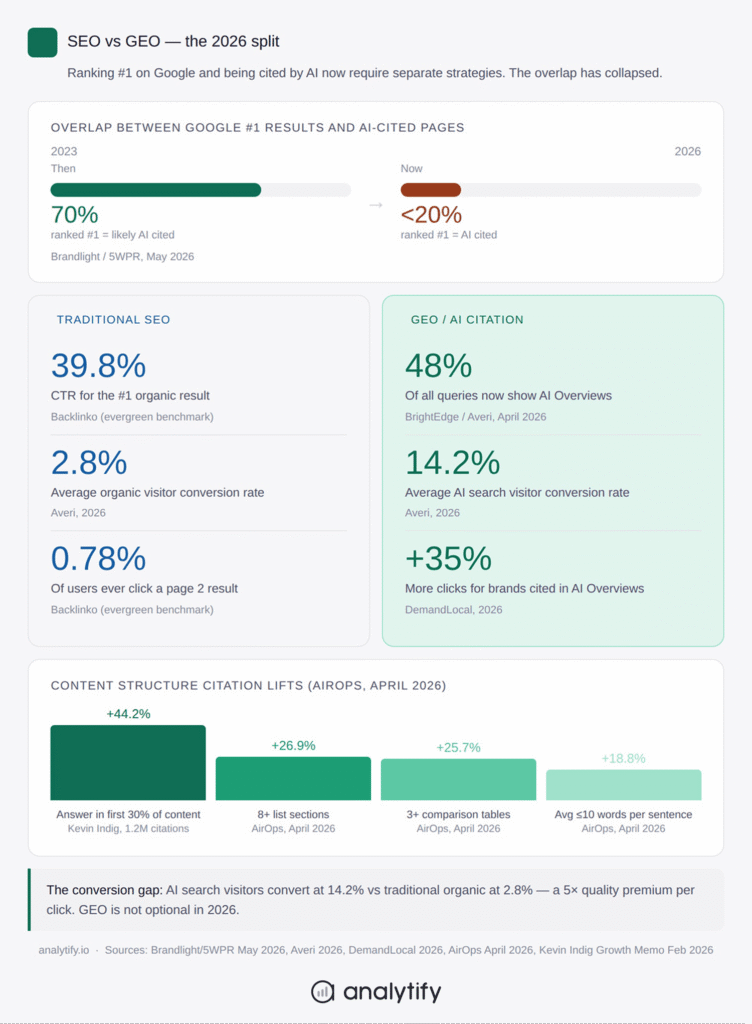
The divergence between Google rankings and AI citations is confirmed. Research from Brandlight, cited in 5WPR’s 2026 GEO vs. SEO report, shows the overlap between top Google ranking pages and AI-cited sources has collapsed from 70% to below 20%.
Ranking #1 on Google no longer guarantees AI citation.
The business case for GEO is measurable:
- AI search visitors convert at 14.2% versus traditional organic’s 2.8%, a 5x quality premium per click
- Brands cited in AI Overviews earn 35% more organic clicks than brands that are not cited (Seer Interactive study)
- AI Overviews appear on over 40% of US searches, reaching 2 billion monthly users
- Only 15% of pages ChatGPT retrieves for commercial prompts earn a citation in the final answer (AirOps, 217,508 pages across 7,500 prompts)
What makes content AI-citable:
- Direct answers at the top of every section. 44.2% of ChatGPT citations come from the first 30% of content, per Kevin Indig’s analysis of 1.2 million verified ChatGPT citations. The first sentence after every heading must directly answer the heading’s implied question.
- Comparison tables. Pages with 3 or more comparison tables earn 25.7% more AI citations.
- List sections. Pages with 8 or more list sections earn 26.9% more AI citations.
- Short sentences. Averaging 10 words or fewer per sentence increases AI citation probability by 18.8%.
- Self-contained paragraphs. Every paragraph must make sense without the surrounding context. AI engines extract individual passages, not full articles.
- Schema markup. Article schema and FAQPage markup (even without Google rich results) signal structured, extractable content to Bing, Perplexity, and AI crawlers.
- Content freshness. Content under 3 months old is 3x more likely to be cited in AI answers than older, unrefreshed content.
So, GEO and SEO are not the same optimization. Every section in this guide covers a ranking factor that serves both channels. Run both simultaneously, and the same content investment compounds across traditional search and AI-generated answers at once.
How to Track Your Google Ranking Performance
Analytify tracks the impact of every ranking factor improvement directly inside your WordPress dashboard, without switching between Google Analytics 4 and Search Console.
Knowing which factors to prioritize only matters if you can measure the changes that result from acting on them.
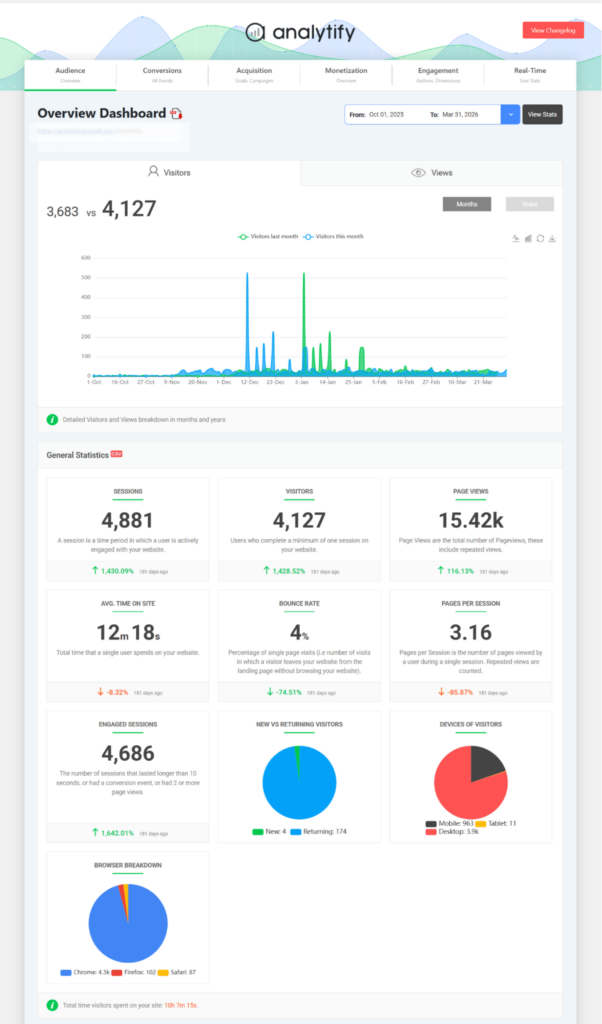
Analytify connects GA4 to your WordPress dashboard and shows per-post traffic data directly below each article in your editor. You can see which posts are growing in sessions, how engagement time is trending, and where traffic drops off without leaving WordPress.
What to track after optimizing for Google ranking factors:
- Organic sessions week-over-week: GA4 >> Acquisition >> Traffic Acquisition >> filter Organic Search
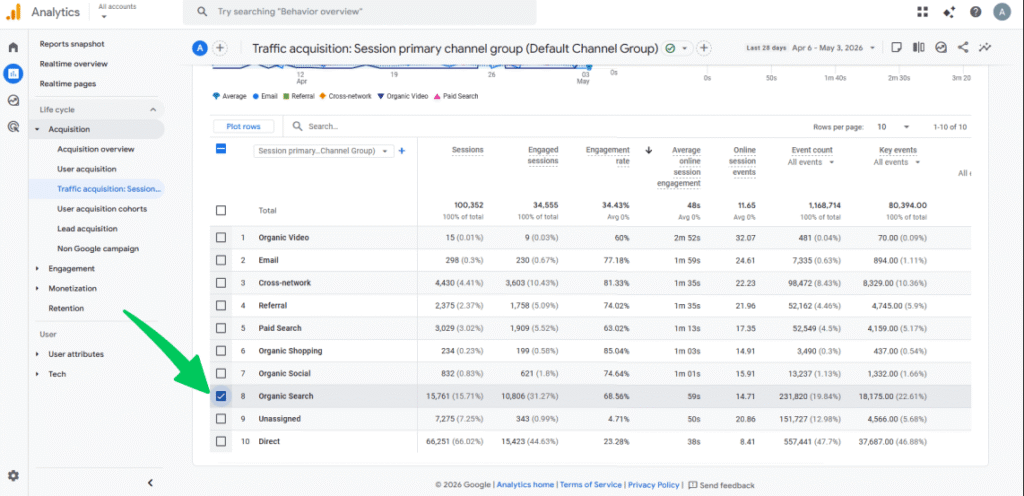
- Average engagement time by page: GA4 >> Engagement >> Pages and Screens
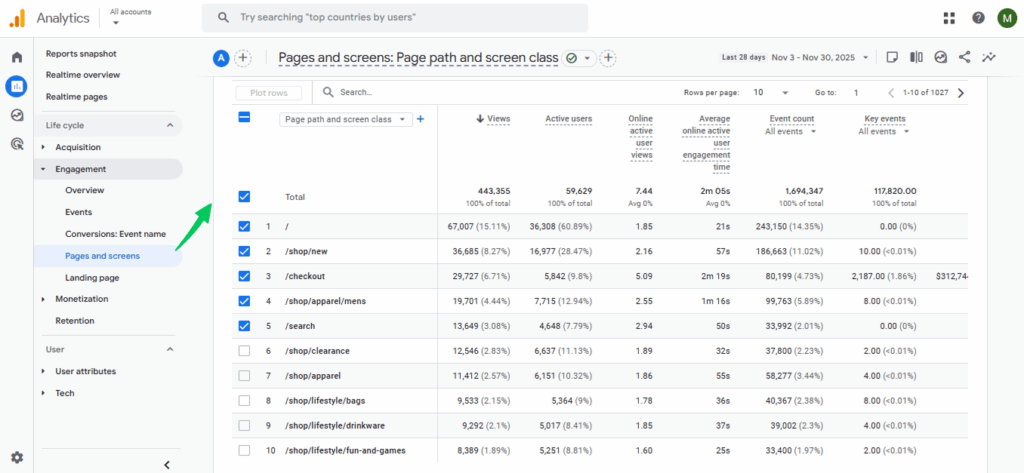
- CTR by page: Google Search Console >> Performance >> filter by page
- Core Web Vitals by URL: Search Console >> Core Web Vitals
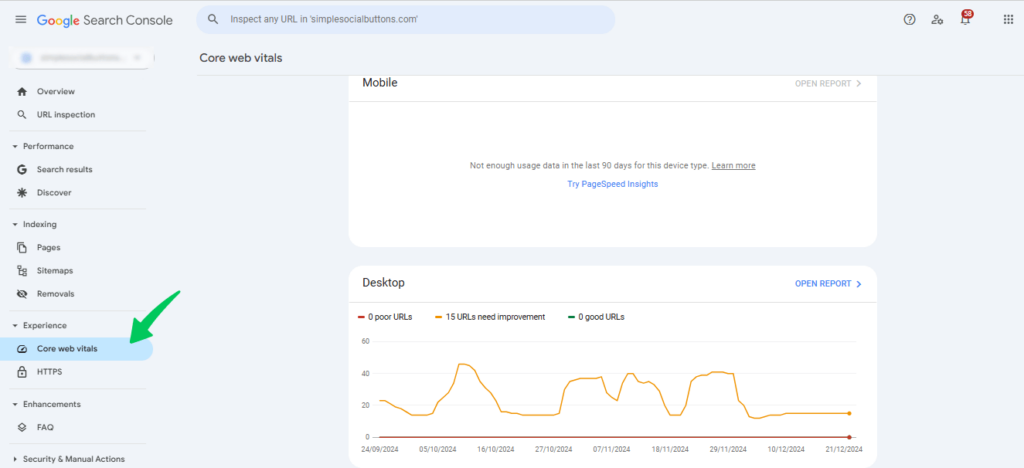
Analytify Pro adds WooCommerce revenue tracking, form submission tracking, and author-level performance data.

Google Ranking Factors Quick Reference for 2026
The table below ranks the Google ranking factors by priority and impact.
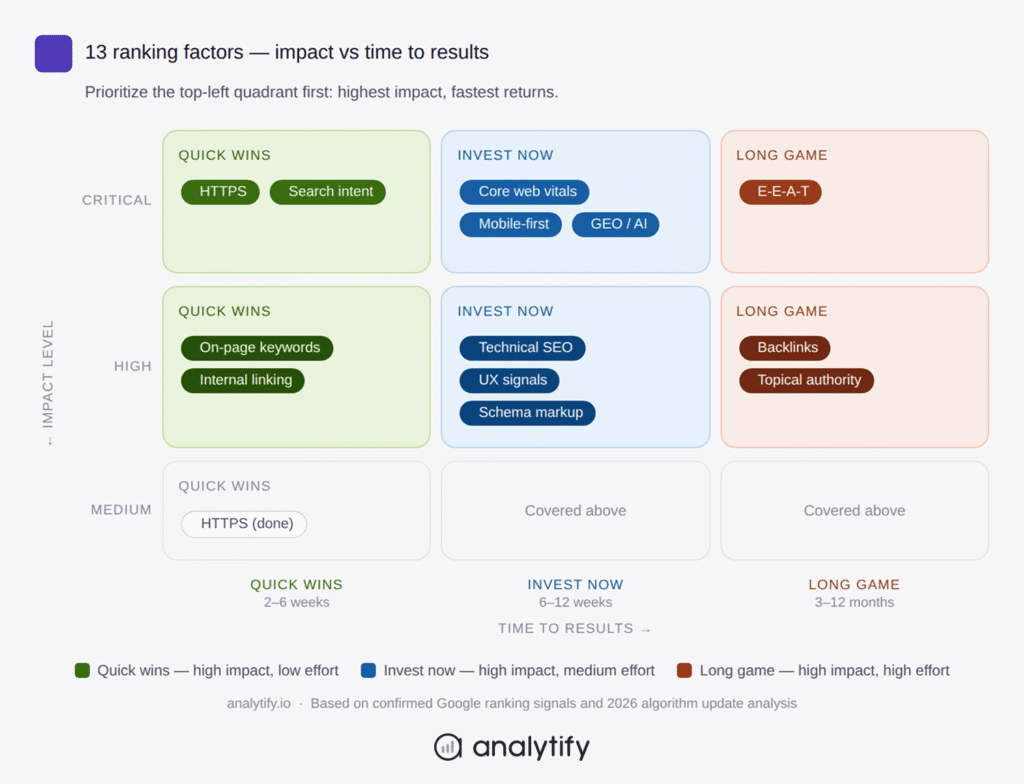
| Ranking Factor | Priority | Effort to Fix | Time to See Results |
|---|---|---|---|
| E-E-A-T / Content quality | Critical | High | 3 to 6 months |
| Core Web Vitals | Critical | Medium | 2 to 4 weeks |
| Search intent match | Critical | Low to Medium | 2 to 8 weeks |
| Topical authority | High | High | 3 to 12 months |
| Backlinks | High | High | 2 to 6 months |
| Mobile-first optimization | High | Low to Medium | Immediate to 4 weeks |
| On-page keyword optimization | High | Low | 2 to 6 weeks |
| Technical SEO | High | Medium | 2 to 6 weeks |
| HTTPS | Medium | Low | Immediate |
| UX signals | High | Medium | 4 to 12 weeks |
| Schema markup (Article, Product) | Medium | Low | 2 to 4 weeks |
| Internal linking | Medium | Low | 4 to 12 weeks |
| GEO / AI search optimization | Critical (emerging) | Medium | 4 to 12 weeks |
Google Ranking Factors: Frequently Asked Questions
What are the top 3 Google ranking factors in 2026?
Content quality (E-E-A-T), Core Web Vitals, and search intent match are the three highest-impact Google ranking factors in 2026. All three are sitewide or behavioral signals. Weakness in any one area can suppress well-optimized pages across your entire domain. Google’s Helpful Content System enforces content quality at the site level, not just the page level, making these three the essential starting point for any ranking improvement effort.
How many ranking factors does Google use?
Google uses over 200 confirmed ranking signals, though the exact number and weight of each are not publicly disclosed. Google has confirmed a core set including Core Web Vitals, mobile-first indexing, HTTPS, E-E-A-T, backlinks, and content relevance.
Does AI-generated content affect Google rankings?
No. AI-generated content does not affect Google ranking if it meets E-E-A-T standards and provides genuine value to users. Google’s ranking systems evaluate content quality not production method. However, AI-generated content published at scale without editorial oversight or first-hand accuracy review is actively suppressed by Google’s Helpful Content System. Reviewed, accurate, and experience-backed AI-assisted content can rank normally.
Why is my content not ranking despite good SEO?
Content that does not rank despite on-page optimization typically has one of four problems: weak E-E-A-T (no author authority or first-hand experience signals), a search intent mismatch (format or depth does not match what top-ranking pages deliver), insufficient topical authority (no supporting cluster articles), or poor Core Web Vitals scores dragging down the page experience signal. Check intent first, then E-E-A-T, then technical performance.
What is GEO and how is it different from SEO?
GEO (Generative Engine Optimization) is the practice of structuring content so AI search engines (Google AI Overviews, ChatGPT, Perplexity, and Gemini) cite it in their generated answers. SEO focuses on ranking in traditional Google search results. Research from Brandlight (2026) shows that fewer than 20% of pages ranking #1 on Google also appear in AI-generated answers. The two channels require parallel but different optimization strategies.
Does FAQ schema still matter after Google’s May 2026 update?
FAQ rich results were officially deprecated by Google on May 7, 2026. They no longer appear as visual SERP dropdowns for any website. However, FAQPage schema markup itself remains valid and should not be removed. Google confirmed it still uses the markup to understand page content. Bing, Perplexity, and other AI crawlers continue to process FAQPage schema for their own results.
How often does Google update its ranking algorithm?
Google makes between 500 and 600 algorithmic updates per year and confirms several named major updates annually. Broad Core Updates typically happen 3 to 4 times per year. Spam, product review, and Helpful Content updates run on separate, continuous schedules. The most stable strategy is focusing on long-term quality signals (E-E-A-T, topical authority, backlinks) rather than optimizations targeting individual algorithm features.
Google Ranking Factors: Final Verdict
Google ranking factors do not operate in isolation. A page with strong E-E-A-T but poor Core Web Vitals loses the page experience signal. A page with fast load times but a search intent mismatch loses the click. Every factor in this guide interacts with the others, which means fixing one without auditing the rest produces partial results at best.
Three actions to take this week:
- Run Google PageSpeed Insights on your top 5 pages and fix any Core Web Vitals failures. Only 33% of websites currently pass all three thresholds. Fixing yours is a direct competitive advantage over two-thirds of the web.
- Search your top 5 target keywords in Google and compare your page format to the top 3 results. If your format does not match a listicle ranking where you published a long-form guide, or a product page ranking where you published a blog post, intent realignment is your single highest-priority fix before any other optimization.
- Open your site’s main topic and list every supporting cluster article you are missing. Each gap is a topical authority signal your competitors may already be filling.
Knowing which factors to fix means nothing without knowing whether those fixes are working. Most WordPress site owners cannot answer a simple question: which of my articles gained organic traffic this week and which lost it?
Checking that requires opening GA4, filtering by organic channel, cross-referencing Search Console, and manually matching URLs to posts. Analytify shows per-post GA4 traffic data directly inside your WordPress editor, so you can see which articles are gaining or losing organic sessions without leaving WordPress. Download it free and start tracking the impact of every change you make from this guide.
Further Readings:

Google’s lies…it was like that until about two years ago. Now they are prioritizing social media content and texts generated by artificial intelligence, and punishing articles based on real experiences. Bing and DuckDuckGo’s results are much better.
Great information shared.. really enjoyed reading this post thank you author for sharing this post .. appreciated
Thank you so much for your kind words! I’m glad you enjoyed the post. Your feedback is greatly appreciated!
Best,
Saud