Off-Page SEO Checklist: Best Strategies and Tips (2026)

My team and I have built backlinks, earned mentions, and landed guest posts for WordPress products for years. For a long time, we still could not say for certain if any of it moved rankings or traffic.
This is the best off page SEO checklist we have put together to close that gap. Every tactic here is paired with a way to verify it worked, because a tactic you cannot measure is just a guess.
This guide covers what off-page SEO means, the off page SEO strategies we rely on most (link building, brand mentions, and digital PR), the tools we use to track them, and how we measure results in WordPress with Analytify.
In this Article:
What Is Off-Page SEO?
What is off-page SEO? Off-page SEO is every action taken away from your own website, including backlinks, brand mentions, social sharing, and digital PR, that builds the trust and authority search engines and AI systems use to rank a website.
On-page SEO covers content and structure controlled directly on a site. Off-page SEO is everything earned elsewhere: links, mentions, social sharing, reviews, and digital PR outreach.
AI search tools like ChatGPT and Google AI Overviews weigh these same off-site signals when choosing which sources to cite. A site with strong backlinks and consistent brand mentions gets both better rankings and more AI citations.
This checklist focuses on what off-page SEO covers today. The core areas my team tracks are backlinks, brand mentions, social signals, and measurement, each covered below.
What Are the Most Important Off-Page SEO Ranking Factors?
The most important off page SEO ranking factors are backlink quality and relevance, brand mentions (linked and unlinked), branded search volume, and social signals, in roughly that order of impact.
Backlink quality and relevance carry the most weight. A single link from a relevant, authoritative site has outperformed dozens of links from unrelated directories in every campaign my team has run.
Brand mentions matter even without a link. Search engines can recognize a business name across the web and treat it as an E-E-A-T signal, linked or not.
Branded search volume works as a trust proxy. When people search for a brand name directly, it signals real demand, and we watch this closely after any PR push.
Social signals influence ranking indirectly. Shares and engagement do not move rankings alone, but they increase visibility, which leads to more links and mentions over time.
The gap between top-ranking pages and everyone else is significant. Backlink studies referenced across multiple 2026 SEO guides suggest the top-ranking Google result has roughly 3.8 times more backlinks than pages ranked two through ten.
| Factor | What It Signals | How to Influence It |
| Backlink quality and relevance | Third-party trust in your content | Earn links from topically relevant, authoritative sites |
| Brand mentions (linked and unlinked) | Recognition and reputation across the web | Digital PR, guest expertise, press coverage |
| Branded search volume | Real-world demand and trust for your brand | Consistent visibility that drives people to search your name |
| Social signals | Indirect visibility and content distribution | Active, consistent sharing and engagement |
Once you understand these factors, you can build them into a checklist worth repeating, instead of chasing whatever tactic is trending that month.
What Should Be Included in an Off-Page SEO Checklist for 2026?
A complete off page SEO checklist for 2026 covers six areas: backlink audits and competitor gap analysis, link building, trust listings, brand mention tracking, authority-building tactics beyond links, and measuring the results.
Skim this section alone, and you have the entire checklist. Everything below is explained in more depth further down the page, but nothing here requires reading further to use it.
1. Backlink Profile
☐ Run a full backlink audit: referring domains, anchor text distribution, toxic links
☐ Run a competitor backlink gap analysis
☐ Disavow toxic or spammy links through Google Search Console
2. Link Building
☐ Guest post on 2+ topically relevant sites this quarter
☐ Create one linkable asset: original research, data study, or free tool
☐ Reclaim broken links pointing to dead or outdated pages in your niche
☐ Pitch expert commentary to journalists and bloggers covering your topic
☐ Get listed on the WordPress Plugin Directory and Capterra
3. Brand Mentions
☐ Set up a media or brand monitoring tool, or Google Alerts as a free option
☐ Log every unlinked mention you find
☐ Reach out to convert 2+ unlinked mentions into links this quarter
4. Authority Beyond Backlinks
☐ Participate in WordPress.org support forums, or relevant Reddit threads
☐ Post consistently on 2 to 3 social platforms where your audience actually is
☐ Claim and update local citation listings, if you have a physical location
☐ Publish a press release for your next major release or feature launch
5. Tools
☐ Set up a paid backlink-tracking platform (such as Semrush), or rely on Search Console
☐ Set up mention monitoring: a media tool or Google Alerts
☐ Check G2 and Capterra for new reviews monthly
6. Measure the Results
☐ Connect Analytify to track referral traffic from every backlink and mention
☐ Check branded search query growth inside wp-admin with Analytify and Search Console
☐ Review landing page performance for the pages you built links to
☐ Repeat this entire checklist every quarter
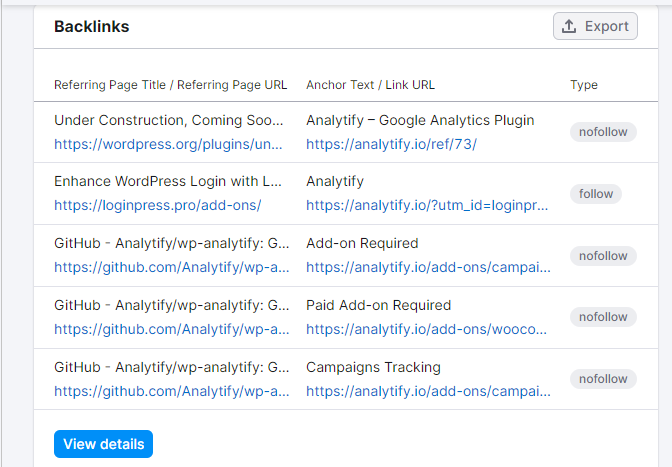
How Do You Audit Your Backlink Profile?
Auditing your backlink profile means reviewing every link pointing to your site to separate the ones building backlink quality from the ones that could be dragging it down.
Run this audit at least once per quarter. Here is what to check, in order:
- Referring domains: how many unique sites link to you, not just how many total links exist
- Anchor text distribution: a natural mix of branded, generic, and keyword anchors, not the same exact-match phrase repeated
- Toxic or spammy links: links from unrelated, low-quality, or clearly automated sites
- Competitor backlink gap: sites linking to competing plugins but not to yours, often the fastest source of new link prospects
Once toxic links are flagged, disavow them through Google Search Console. A backlink-checking tool speeds this up, but the list still needs a human review first.
How Do You Build High-Quality Backlinks?
Building high-quality backlinks means earning links from relevant, authoritative sites through guest content, digital PR, and assets other sites want to reference, not buying links or mass-submitting to directories.
These are the five link-building strategies that consistently produce results for our team:
- Guest posting on topically relevant sites: it puts your name and link in front of an audience that already trusts the host site
- Creating linkable assets like original research, data studies, or free tools: other sites cite data, not opinions
- Broken-link reclamation: offer your own content as a replacement for a dead link, which gives the site owner an easy win
- Expert commentary and interviews: journalists need quotable sources, and a good quote often earns a link back
- Directory and review platform listings: getting listed in the WordPress Plugin Directory and on G2 or Capterra earns a backlink and a trust signal at once, since buyers check reviews before installing

Quick Tip: None of these work as a one-time push. Treat link building as an ongoing part of the content calendar, not a campaign you run once and forget.
How Do You Earn Brand Mentions for SEO?
Earning brand mentions for SEO means getting your business named across the web, whether or not the mention includes a link, since search engines and AI tools can both register unlinked mentions as trust signals.
My team focuses on four sources: press coverage, podcast or webinar appearances, user-generated content campaigns, and a media monitoring tool that flags mentions as they happen.
Unlinked mentions still count for E-E-A-T and AI visibility. A publication naming your brand without a hyperlink is still doing work for you.
What Off-Page SEO Tactics Build Authority Beyond Backlinks?
Beyond backlinks, the off page SEO tactics that build the most authority are forum and community participation, consistent social sharing, local citations, and press releases for major announcements.
Forum and community participation matter more in 2026. Reddit threads show up more often in AI search citations, and WordPress.org support forums build the same authority with a more relevant audience.
Social sharing works best when it is deliberate. Pick two or three platforms where your audience actually spends time and keep each profile complete and consistent.
Local citations matter for any business with a physical location. Consistent name, address, and phone number listings build the same trust signal as a backlink.
Press releases add a layer of authority worth keeping in the mix. Publishing one for a major version update, distributed through a PR service, earns coverage a routine blog post will not.
Which Off-Page SEO Tools Help Track Backlinks and Brand Mentions?
The most useful off page SEO tools split into two categories: backlink trackers and brand or media monitoring tools.
For backlink tracking, my team uses a paid platform such as Semrush for referring-domain data and toxic-link scoring, plus Google Search Console as a free baseline.
For mention monitoring, a media monitoring service catches press coverage and larger publications, while Google Alerts works as a free option. For plugin and SaaS products, checking G2 and Capterra directly also surfaces review-based mentions that alert tools often miss.
Tracking tools show that the activity is happening. The next section covers how to check whether that activity is actually paying off.
How Can You Measure the Impact of Off-Page SEO Inside WordPress?
You can measure off-page SEO’s real impact by tracking referral traffic sources, branded search query growth, and landing page performance for the pages that received backlinks or mentions, all viewable inside WordPress with Analytify.
Checking GA4 and Search Console separately used to eat entire afternoons. Now Analytify shows referral traffic, branded search growth, and landing page performance together inside the WordPress dashboard.
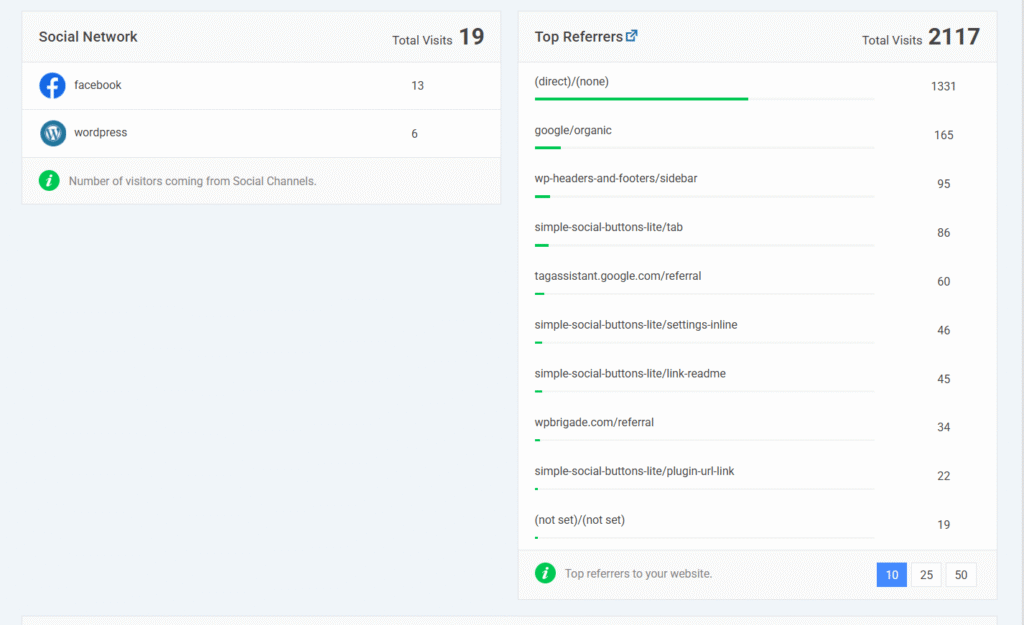
Analytify surfaces GA4’s referral traffic report, so you can see which sites are sending visitors after a guest post or mention goes live.
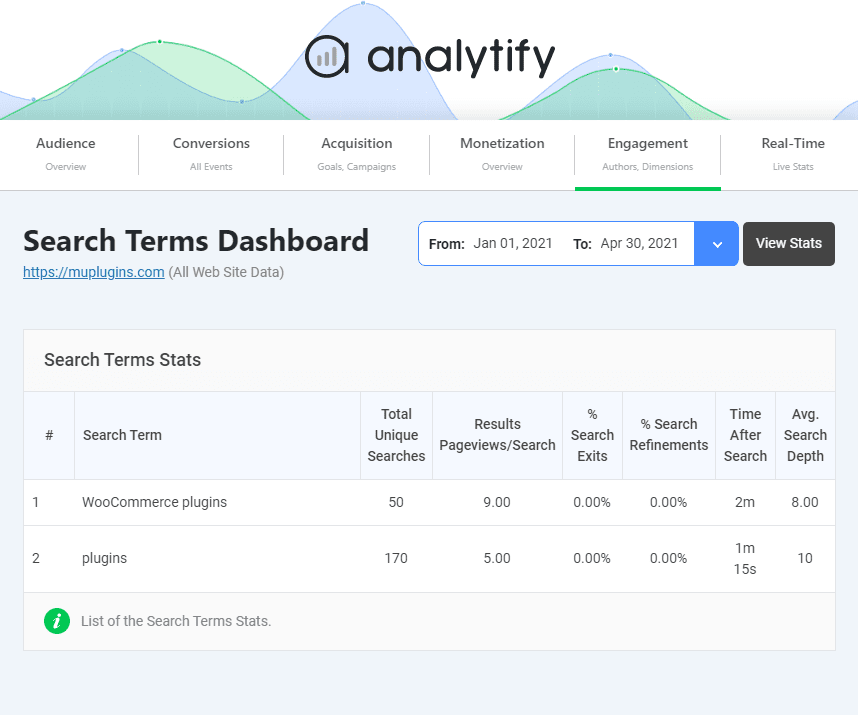
Analytify connects GA4 with Google Search Console to show branded search query growth inside wp-admin. GA4 alone does not provide keyword-level data without that connection.
Analytify’s landing page reports show whether the page that earned a backlink is actually converting that traffic, not just receiving it.
Analytify does not build links or generate mentions. It is the measurement layer my team relies on to see whether the off-page work already done is paying off, which is where most seo analytics tools fall short for WordPress site owners.
What Are Off-Page SEO Best Practices to Avoid Common Mistakes?
The most important off-page SEO best practices are prioritizing link relevance over volume, keeping anchor text natural and varied, and never buying links from unrelated sites.
These are the five mistakes my team watches for on every audit:
- Over-optimized exact-match anchors: vary anchor text naturally instead of repeating the same phrase on every link
- Buying links from link farms or unrelated directories: these get flagged and hurt more than they help
- Ignoring unlinked brand mentions: track them too, since they still carry E-E-A-T weight
- Treating off-page SEO as a one-time project: link building and PR need to run continuously
- Skipping measurement entirely: without checking referral traffic and branded search growth, there is no way to know what is worth repeating
Frequently Asked Questions
1. What should be included in an off-page SEO checklist for 2026?
A complete off-page SEO checklist for 2026 covers backlink audits, link building, brand mention tracking, authority-building tactics like digital PR and forum participation, and measuring the results with analytics data. Skipping measurement is the most common gap we see.
2. What is the difference between on-page and off-page SEO?
On-page SEO covers everything controlled directly on a website, like content, title tags, and internal links. Off-page SEO covers actions that happen elsewhere, like backlinks, brand mentions, and social sharing.
3. How long does off-page SEO take to show results?
Most off-page SEO efforts take three to six months to show measurable ranking movement, depending on niche competitiveness and consistency of execution. Backlinks and brand mentions compound over time rather than producing an instant jump.
4. Are backlinks still important for SEO in 2026?
Yes, backlinks remain one of the strongest ranking signals, but quality and relevance matter far more than volume now. A 2025 survey of over 500 SEO professionals found that 73.2% believe backlinks also influence a site’s chances of appearing in AI search results.
5. Do brand mentions help SEO even without a link?
Yes, search engines can recognize brand mentions even without a hyperlink, and unlinked mentions still contribute to E-E-A-T signals. This makes press coverage and expert commentary valuable even when a publication does not link back.
6. Why is analytics important for measuring off-page SEO results?
Analytics show whether the traffic and visibility from off-page efforts actually convert into results by tracking referral sources, branded search growth, and landing page performance for the pages that earned backlinks or mentions. Without this step, there is no way to know which tactics are worth repeating.
Off Page SEO Tactics: Final Words
Off-page SEO only works if you can prove it worked. That is the standard my team holds every campaign to: measuring referral traffic, branded search, and conversions alongside the link-building and PR work itself.
Here is what to do next:
- Run a backlink audit this month and flag any toxic or irrelevant links for disavowal
- Pick one off-page tactic from this checklist (guest posting, digital PR, or forum participation) and commit to it consistently for a full quarter
- Connect Analytify to see referral traffic, branded search growth, and landing page performance for the pages you are actively building links to
See how Analytify tracks your off-page SEO results: visit the Analytify pricing and plans page to get started.
Further Readings: