Ultimate B2B SEO Guide: From Strategy to Measurable Growth

B2B SEO is the process of optimizing a business website to rank for keywords that other businesses use when researching solutions, with the goal of generating qualified leads through organic search.
Your B2B website is getting organic traffic, but when senior management asks whether SEO is actually generating qualified leads, you hesitate.
By the end of this guide, you will have a complete B2B SEO strategy, a clear list of KPIs that prove pipeline impact, and a practical way to track progress inside WordPress.
Table of Contents
What Is B2B SEO and How Is It Different from B2C SEO?
B2B SEO means optimizing your website so it appears in search results when business buyers search. The main goal is to get qualified leads, not just quick individual sales.
In B2C, the buyer is typically a single individual making a personal purchase decision.
For instance, if you sell leather goods, you focus on individuals who wear leather. Your marketing is aimed at that one type of customer.
Business-to-business buying is much more complex. Your customer is an entire organization rather than one individual.
Because of this difference, you need to identify the specific stakeholders inside that company who influence the buying process.
These users might be product managers, financial leads, or operations directors. Pinpointing these roles helps you predict exactly what they search for in Google.
When you understand these different roles, you can do more focused keyword research. Organic SEO still drives 76% of all trackable B2B website traffic, according to SeoSherpa statistics.
| Category | B2B SEO | B2C SEO |
| Buyer type | A professional buying on behalf of a company | An individual buying for personal use |
| Sales cycle length | Weeks to months, involving multiple stakeholders | Hours to days, often a single decision-maker |
| Search volume vs. intent value | Low volume, high intent, high contract value | High volume, lower intent per visitor |
| Content type | Comparison guides, technical documentation, case studies | Product pages, reviews, lifestyle content |
| Primary success metric | Qualified leads and pipeline contribution | Revenue from transactions |
How Do You Build a B2B SEO Strategy Step by Step?
A B2B SEO strategy has four core components: define your buyer, research high-intent keywords, publish decision-stage content, and measure results against pipeline metrics.
Here are the four steps you can follow to build a B2B SEO strategy:
Step 01: Define Your Buyer Profile
The first step in defining a good B2B SEO strategy is knowing exactly who you are trying to reach.
You can start by identifying their job title, the problems they are paid to solve, and the questions they search for before talking to sales. Without this profile, every other step is guesswork.
You can use user persona generator tools to create a detailed target user persona to help you develop your strategy around your niche buyers.

Step 02: Choose Keywords That Match Buying Intent First
Start by avoiding broad, high-traffic keywords and focus on low-volume search terms that show a buyer is seriously considering a product or service.
For instance, look at how search volumes differ between competing search terms. As shown in the images below, the keyword “kobo vs kindle” drives substantial search volume, while a challenger keyword like “boox vs kindle” has much lower volume.
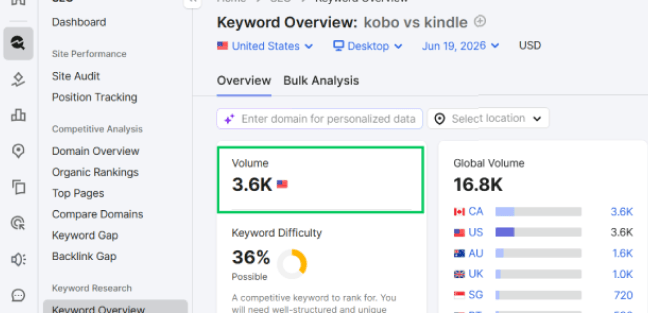
However, if you are building an SEO strategy for a niche challenger brand like Boox vs. Kindle, targeting these lower-volume, highly specific comparison terms is the perfect starting point.
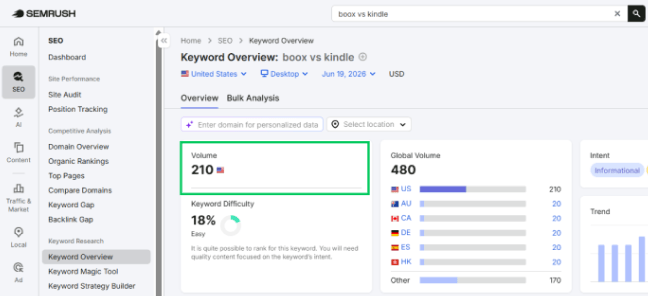
It allows you to capture high-intent users early without fighting massive initial competition. This approach also ensures your content aligns perfectly with the buyer’s current stage in the sales funnel.
Many B2B companies see thought leadership as mostly a way to boost brand awareness, not a driver of revenue. But the data shows a different picture.
As highlighted in the New York Times Licensing, 48% of thought leadership content generates actual leads and sales

This shows that when you go beyond generic advice and share well-researched, expert content, you do more than educate the market. You also help drive confident buying decisions at the bottom of the funnel.
Using these strategies together helps corporate teams turn organic search traffic into real sales opportunities.
Other ways to find buyers at the bottom of your funnel include using Google’s People Also Asked or dedicated SEO tools such as Semrush and Ahrefs to identify low-volume, high-intent keywords to target.

After capturing high-intent traffic with bottom-of-the-funnel keywords, move to audiences higher up the funnel.
While they aren’t ready to convert immediately, delivering a personalized experience will help close the gap.
Step 03: Build Scalable Content for Product/Service
Most B2B content targets broad awareness topics and never reaches the decision stage, which is exactly where deals are won, and decision-makers need to be impressed.
It is crucial that your published content produces answers to what your potential buyers are looking for. This can include publishing comparison pages, detailed integration guides, and ROI frameworks for social proof.
One real-life example is how we handle our content strategy at Analytify. When we noticed that more users were searching for ways to prevent double hits in Google Tag Manager, we created a clear answer.
We developed a deep-dive technical guide, Analytify Script With Custom GTM Tracking (No Double Hits), built entirely around that specific user query.
Instead of chasing broad, generic keywords, we focused on directly solving a high-intent, product-related pain point for our readers, giving them an immediate, actionable solution
Step 04: Measure Results Against Pipeline Metrics
Organic sessions are not a B2B KPI. Rather than treating session counts as a goal, a solid B2B SEO strategy should focus on revenue- or conversion-related metrics. This is due to the complexity of user journeys in B2B marketing, where traffic volume alone won’t reflect real changes.
This is why it is essential that you track leads from organic search, form submissions by landing page, and assisted conversions. Connect content performance to real pipeline data.
Your SEO goal for B2B is not to rank but to be found, trusted, and remembered during the research phase, before the buyer ever fills out a form.

Knowing your strategy is only the first step. The keywords you choose determine whether you attract real buyers or just traffic. Here is a detailed way to research B2B keywords the right way.
How Does B2B Keyword Research Work for SaaS and Services?
In B2B keyword research, it’s better to target low-volume, high-intent keywords that decision-makers use, instead of high-volume terms that attract general audiences.
For example, a keyword with just 50 monthly searches but linked to a $50,000 contract is more valuable than one with 50,000 searches and no real buying intent.
Many B2B teams make the mistake of focusing only on search volume. Instead of asking, “How many people search for this?” they should ask, “What are the right people searching for just before they make a purchase?”
What Keyword Types Should B2B SaaS and Service Businesses Target?
Here is a keyword type summary for B2B SaaS and service businesses:
| Keyword Type | Example | Buyer Stage | Best Content Format |
| Problem-aware | “Why does the sales team miss quota” | Early research | Educational guide or blog post |
| Solution-aware | “CRM software for professional services” | Category evaluation | Pillar page or feature comparison |
| Comparison/alternative | “HubSpot vs Salesforce for B2B” | Pre-purchase shortlisting | Comparison page or alternative page |
| Use-case/industry | “project management software for agencies” | Evaluation | Use-case landing page |
Each type maps to a different moment in the buyer’s journey. Ranking for all four gives you coverage across the full research phase.
How To Find These Keywords Without Relying On Paid Tools?
Start with the problem your buyer has before they even know a solution exists. Work backward from sales call transcripts. The exact language a prospect uses on a discovery call is often a keyword nobody else is targeting yet.
Then use Google autocomplete. Type “[problem] software” or “[problem] solution for [industry]” and read what Google suggests. Those suggestions reflect real search behavior at scale.
Google Search Central confirms that search intent, not just keyword match, shapes how pages rank.
A page that matches exactly what a buyer wants at a specific stage will outrank a generic page with higher domain authority.
Finally, check the “People also ask” and “Related searches” sections for every seed query. You can also use this seed keyword tool to find the questions buyers ask before and after your product.
All you need to do is create a scenario that maps those questions to content gaps.

Strong keyword research is only useful if your content format matches the buyer’s intent. Here is what content actually works in B2B SEO.
What Type of Content Works Best for B2B SEO?
The B2B content that gets the best rankings and attracts qualified traffic usually comes in four main formats: long-form educational guides that answer buyers’ questions during research, comparison pages for buyers weighing their options, case studies that help convert interest into leads, and glossary and definitions pages for buyer awareness and trust.
Each of these formats matches a different stage in the buying process. By publishing all four types listed below, you can reach buyers from their first search to their final decision.

B2B content types mapped to funnel stage:
- Long-form educational guides (Awareness): These guides answer the “what is” and “how does” questions that buyers have early in their research. Focus on keywords that show buyers are aware of the problem or potential solutions. Try to write 1,500 to 2,500 words, use clear headings, and give a direct answer right at the start. Google prefers pages that meet search intent without hiding the answer.
- Comparison pages (Consideration): These capture buyers actively shortlisting vendors. Cover feature differences, pricing transparency, and use-case fit. This is where b2b keyword research and content strategy converge most directly. A comparison page targeting a high-intent query can drive more qualified leads than ten awareness posts.
- Case studies (Decision): Buyers at this stage want proof, not promises. A case study that shows a measurable result for a recognizable company type does the work your sales team used to do.
- Glossary and definition pages (Awareness and Trust): These pages help you build authority in your topic area. They show up in search results for “what is” questions and often get backlinks from others who use your definitions.
Creating a funnel-mapped content calendar is just the beginning. After your targeted content goes live, focus on tracking how well it moves buyers through your pipeline.
You no longer need to step outside WordPress to check analytics. Instead, use per-post stats in your WordPress dashboard to check how each article is doing.
This way, you can quickly see which bottom-of-funnel pages perform best or notice if awareness posts lose readers early, helping you adjust your strategy as needed.

After you have the right keywords and content, your site’s technical setup decides if Google can find and rank your pages.
What Are the B2B SEO Best Practices for Technical Foundations?
B2B SEO technical basics focus on five key areas: site speed, mobile usability, crawlability, internal linking, and schema markup.
If you spot problems early, you usually won’t need a developer. Each of these factors can impact your rankings, no matter how good your content is.
Technical SEO checklist for B2B sites:
Core Web Vitals and page speed matter for rankings. Google uses these speed and stability metrics to measure real user experience. If your pages don’t meet Core Web Vitals standards, they may rank lower than similar pages that do.
Check your site’s status in Google Search Console. Start by fixing the biggest problems, such as compressing images, removing render-blocking scripts, and improving server response times.
Keep your URL structure clean and make sure there are no orphaned pages. Every page should be accessible within three clicks from your homepage.
Orphaned pages, which have no internal links, are not prioritized for crawling. Review your site structure before adding new content.
Use internal links to strengthen your topic clusters. Link supporting articles back to your main pillar page, and connect related cluster posts.
Learn more about technical SEO in our guide: What is a Technical SEO Audit for SaaS and How Do You Execute the Checklist?
This helps distribute authority throughout your content and signals to Google that your site covers the topic thoroughly.

Next, you can add the FAQPage and HowTo schema to the right content. Schema markup is structured data that helps Google display your content as rich results in search results.
Use the FAQPage schema for posts with Q&A sections, and the HowTo schema for step-by-step guides. Both can help boost your click-through rates from search results.
Double-check your XML sitemap and robots.txt file. Submit your sitemap to Google Search Console.
Make sure your robots.txt file isn’t blocking any pages you want Google to index. This quick check can save you from losing rankings for months.
Once your technical foundation is set, start measuring whether the metrics you’re improving are the ones that matter for your business. The real work is in ongoing optimization and tracking how effectively it moves buyers through your pipeline.
You don’t have to use outside analytics tools every time you publish. Instead, check each page and post stats in your WordPress dashboard using Analytify’s overview dashboard:
Which B2B SEO Metrics and KPIs Should You Actually Track?
The B2B SEO metrics that matter are qualified organic conversions, high-intent keyword rankings, and organic-attributed pipeline, not total traffic volume alone.
Traffic without conversion data is noise. A post with 5,000 monthly visitors and zero form fills is not an SEO win. Here is what actually tells you SEO is working:
Which KPIs Should B2B SEO Teams Track?
| KPI | What It Measures | Where to Find It | Why It Matters for B2B |
| Organic goal completions | Form fills, demo requests, and content downloads from organic visitors | GA4 (Google Analytics 4) Conversions report | Directly connects SEO to lead generation |
| High-intent keyword positions | Rankings for buying-stage keywords only, not all keywords | Google Search Console, Position tracking | Low-volume terms with high intent drive real pipeline |
| Organic traffic to conversion pages | Sessions from organic search landing on demo, contact, or pricing pages | GA4 Traffic Acquisition report, filtered by organic | Shows whether SEO is reaching decision-stage buyers |
| Return visitor rate from organic | Organic visitors who return within 30 days | GA4 User Acquisition report | Signals content authority and buyer research behavior |
| Organic-attributed pipeline | Revenue opportunities sourced from organic search | CRM + GA4 integration (requires setup) | The final proof that SEO contributes to revenue |
Tracking these metrics is important because organic leads cost less. You can only see this ROI if you track the right metrics.
If your B2B team uses WordPress, Analytify shows your GA4 organic traffic data, post performance, and goal completions right in the WordPress dashboard.
This means your content team can see the impact of SEO without leaving their usual tools. A writer can open a post, scroll down to the Analytify panel, and quickly check how many organic sessions the post got this month, where visitors came from, and if any goals like form submissions or downloads happened on that page.

First, figure out which metrics matter most. Then, make it a habit to review them regularly so you can use that information to make better decisions.
How Do You Measure B2B SEO Progress Over Time?
To track B2B SEO progress, watch if organic traffic to your high-intent pages is going up, if those pages are getting more form fills or demo requests, and if qualified leads from organic search are increasing each quarter.
One data check won’t tell you much, but regular checks give you the full picture. Here I have provided you with a monthly and quarterly basis checklist to measure your B2B SEO progress over time smartly:
Monthly review checklist:
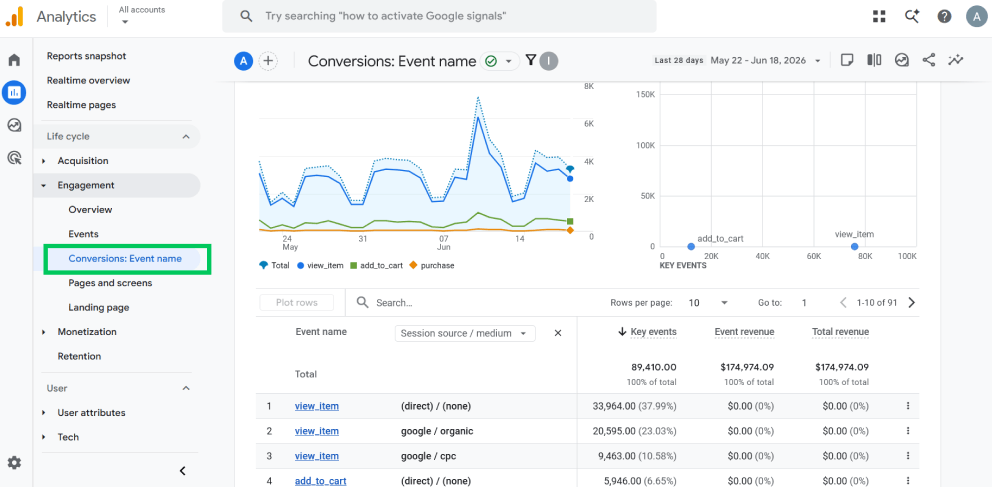
- Check goal completions from organic traffic in GA4. See which pages brought in form fills or demo requests from organic visitors this month. Navigate to GA4 >> Reports >> Engagement >> Conversion Events.


Note: In GA4, you must first ensure an event (such as a form submission or button click) is being recorded, and then mark that specific event as a conversion.
- Focus on how your bottom-of-the-funnel keywords are moving in the rankings. Skip any changes in broad informational keywords that aren’t tied to a buyer stage.
- Open Analytify’s Top Pages by Views dashboard in WordPress and check the organic sessions for your top conversion pages. Mark any post that has a session drop of 20% or more compared to last month.

Quarterly review checklist:
- See how much your organic channel is adding to your pipeline. Pull the leads from organic search in your CRM and compare them to last quarter. You can check your organic sources as well using Analytify’s Social Network and Top Referrers cards.
- Review how your content clusters are performing. Check if your main pillar page ranks higher than its related cluster posts for the main keyword. If it doesn’t, work on your internal links.
- Find any pages where sessions have dropped for two months in a row. These should be your top priority for a content update.
B2B SEO lead generation grows over time if you keep up with these reviews. Refreshing content each quarter based on session drops often helps you recover rankings faster than publishing new posts alone.
Frequently Asked Questions
1. What is B2B SEO, and how is it different from B2C SEO?
B2B SEO is the practice of optimizing a website to rank for searches made by business buyers, with the goal of generating qualified leads through organic search. It differs from B2C SEO in three key ways: the keywords are lower in volume but higher in purchase intent, the content must address multiple decision-makers across a longer sales cycle, and success is measured by lead quality and pipeline contribution rather than transaction volume.
2. How long does B2B SEO take to show results?
B2B SEO typically produces meaningful ranking results in 4 to 6 months, with stronger pipeline impact visible over 9 to 12 months. The timeline depends on domain authority, competitive keyword targets, and publishing consistency. First Page Sage data show a 3-year ROI of 702% for B2B SaaS companies that invest consistently in SEO, making the long payback period worthwhile.
3. What are the most important B2B SEO KPIs to track?
The most important B2B SEO KPIs are organic goal completions (form fills, demo requests), high-intent keyword rankings, organic traffic to conversion-stage pages, and organic-attributed pipeline. Total organic traffic volume is a secondary signal, not a primary KPI, because high traffic from irrelevant searches does not contribute to B2B growth.
4. Is B2B SEO worth it for a SaaS startup?
Yes, B2B SEO is highly effective for SaaS startups because most buyers research solutions extensively online before contacting a vendor. The key caveat is that results require consistent publishing for 6 to 12 months before compounding.
5. How do I do keyword research for a B2B website?
Start with the problems your ideal customer is trying to solve, not with the solution you sell. Search Google for those problems with “software”, “tool”, or “solution” added to see what terms buyers use at each stage. Target low-volume, high-intent keywords, especially comparison terms (“vs” articles) and solution category terms, rather than broad informational keywords with high competition and low buyer intent.
6. How can analytics help with B2B SEO?
Analytics tools help B2B SEO teams identify which organic keywords and pages generate qualified traffic, which content best completes goals, and where buyers drop off in the conversion path. For WordPress-based B2B teams, Analytify surfaces this GA4 data, including per-post organic traffic and goal completions, directly inside the WordPress dashboard without requiring a separate analytics interface.
Conclusion
B2B SEO works when you build it around buyer intent rather than traffic volume, and it compounds when you measure the right things from the start.
The difference between an SEO program that earns budget and one that gets cut is whether you can connect organic traffic to qualified leads.
Your next steps:
- Audit your current keyword list against buyer intent stages: awareness, consideration, and decision. Remove any keyword targets that do not map to a buying stage.
- Set up goal tracking in GA4 for your top three conversion actions (demo request, contact form, content download). Without this, you cannot measure what matters.
- Review your top ten organic landing pages in GA4 this week. Check whether they are generating goal completions. If not, that is your first content improvement priority.
Analytify shows your GA4 organic traffic, per-post performance, and goal completions directly inside your WordPress dashboard. See how it works at Analytify Pro.
Continue building your analytics foundation with these related guides:
- How to Create a Data-Driven Marketing Strategy with Analytify?
- Digital Marketing Analytics for Beginners: A Complete Guide
- Decision Intelligence Marketing: Turning Analytics into Business Actions
Over to you: what’s the one metric your team currently uses to measure SEO success, and does it actually connect to leads or pipeline? Let us know in the comments below!