Growth Signal Tracking: Finding the Metrics That Predict Success

Do you want to learn how to implement growth signal tracking to easily predict the success of your campaigns?
Most marketers track traffic, conversions, and revenue, but those are lagging indicators. By the time they move, the opportunity has already passed.
Identifying growth signals shifts your focus from historical data to predictive leading indicators that forecast success weeks in advance.
In this guide, you’ll learn how to separate meaningful signals from noise and implement a predictive analytics framework for your future campaigns.
Growth Signal Tracking (TOC):
What is Growth Signal Tracking?
Growth signal tracking means finding and watching early signs that can predict future business results, even before you see changes in revenue, conversions, or sales.
Instead of focusing on past results, signal tracking analyzes growth metrics and user actions to predict what might happen next.
It is a key part of modern predictive analytics, helping people make better decisions.
Growth signal tracking helps you:
- Spot growth early: Monitor real-time behavioral shifts to identify scaling opportunities weeks before they manifest in your revenue reports.
- Act before results change: Shift from reactive reporting to a proactive strategy by adjusting campaigns while leading indicators are still in motion.
- Focus on metrics that matter: Filter out vanity metrics to prioritize high-intent micro-conversions with a proven correlation with long-term business success.
What Makes a Good Growth Signal?
Not every data point is a growth signal. To separate predictive insights from background noise, a metric must meet three specific criteria:
- Measurable: The signal must be trackable within your current analytics setup (like GA4) without requiring complex, manual workarounds.
- Predictive: It must show a consistent correlation with future outcomes rather than being a one-time spike or a seasonal anomaly.
- Actionable: You must be able to respond to the data; if a signal drops, there should be a clear strategic lever you can pull to fix it.
What Is the Difference Between Leading and Lagging Indicators?
Not every metric in your dashboard is worth tracking. The key is knowing which type of metric you’re looking at and what it can actually tell you.
Lagging metrics show what has already happened, while leading indicators show what is likely to happen next. Below is a quick difference table for your ease:
| Type | What It Measures | Example | Timing |
| Vanity | Impressions / Noise | Total Page Views | No timing relevance |
| Lagging | Result / Outcome | Total Revenue | After growth |
| Leading | Behavior / Signal | Demo requests | Before growth |
| Predictive | Behavioral trends | High-intent sessions | Forecasts future |
Now let’s go through some of the real use cases for these metrics:
How These Indicators Play Out in Marketing
- Lagging Metrics (Past Results)
These metrics confirm outcomes, but they don’t help you predict growth. They are important for reporting, but they come too late for action.
- Revenue
- Closed deals
- Final conversions
- Leading Indicators (Future Signals)
These are growth indicators based on user behavior and intent. These marketing leading indicators serve as early signals of growth
- Product page visits
- Trial sign-ups
- Email engagement
- Returning users
- Time on high-intent pages
Why Leading Indicators Matter
Leading indicators give you decision confidence. They help you:
- Spot trends early
- Adjust campaigns faster
- Improve conversions before they drop.
For example, if trial sign-ups increase this week, revenue will likely increase in the coming weeks.
What Metrics Predict Business Growth?
These predictive signals act as an early warning system for your future revenue. Here is how to categorize the metrics that bring reasonable results:
1. Engagement-Based Growth Indicators
Engagement is the most reliable leading indicator because users always interact before they convert. If these numbers are climbing, your product-market fit is strengthening. Some of the engagement-based growth metrics are:
- Returning User Rate: Proves your content or product has stickiness.
- Session & Scroll Depth: Measures how deeply users are consuming your value proposition.
- High-Intent Page Views: Tracking visits to pricing or feature pages identifies users close to a decision.
- Micro-Conversions: Small actions like video plays or button clicks that signal active interest.
2. Acquisition Signal Metrics
Since not all traffic is created equal, acquisition-based metrics filter out the noise to show if you are attracting the right audience.
- Branded Search Volume: A rise in searches for your brand name indicates growing authority and trust.
- Organic Velocity: How fast your non-paid traffic is growing.
- Cost Per Qualified Session: Focuses on the efficiency of bringing in ready-to-buy users rather than just clicks.
3. Behavioral Conversion Signals
Behavioral conversion signals help to verify the increase in traffic and finally lead to a conversion. These growth signals reveal the actual user intent.
- Cart and Form Initiations: Tracking how many people start the process tells you whether your offer is compelling, even if they don’t finish.
- Repeated Product Views: Shows a user is in the “consideration” phase and performing due diligence.
- Trial Activations: The ultimate signal of a user moving from a spectator to a participant.
Growth signal tracking focuses on actions, not just visits. By prioritizing behavioral data over raw traffic, you see a clearer picture of your site’s future performance.
How Do Predictive Growth Metrics Work in GA4?
Effective growth signal tracking requires an appropriate analytical setup. GA4 tracks user behavior as events, not just pageviews. That shift makes it the right tool for spotting growth signals before they show up in revenue.
Implementing these metrics is well-suited for identifying predictive growth metrics and leading indicators in marketing.
1. Event-Based Tracking in GA4
GA4 tracks every key action as an event.
Examples:
- Button clicks
- Scroll depth
- Form starts
- Trial sign-ups
This enables detailed measurement of micro-conversions and user behavior. Instead of tracking visits, you track what users do.
2. Funnel Exploration Reports

Funnel Exploration reports show you exactly where users drop off before converting.
Example funnel:
- Visit product page
- Click pricing
- Start trial
- Complete signup
If most users reach step 2 but drop at step 3, that’s your signal. The pricing page is a friction point, not a conversion point.
3. Path Exploration
Path exploration reveals the precise sequence of user actions.
This analysis provides insights into:
- What users do before converting
- Which pages lead to drop-offs
- Common behavior patterns
The patterns you find here often become your most reliable leading indicators.
4. Audience Triggers
GA4 lets you create audiences based on behavior.
Examples:
- Users who visited pricing 2+ times
- Users who started but didn’t finish signing up
- Highly engaged returning users
Once identified, you can target these audiences directly in Google Ads or trigger automated email sequences.
5. Engagement Rate vs Bounce Rate
GA4 substitutes bounce rate with engagement rate.
Engagement rate includes:
- Active sessions
- Time spent
- Interaction events
This gives a clearer view of user behavior analytics and real interest.
Use Cases: Turning Signals Into Predictions
For example:
- Trial sign-ups increase by 20% week-over-week
- Engagement on product pages also rises
That’s growth signal tracking in action: a behavioral trend spotted today predicting a revenue outcome 30–60 days from now.
How to Identify Your Own Growth Signals
Identifying relevant signals does not necessitate advanced data science techniques.
Instead, it involves analyzing the existing customer journey in reverse. The following four-step methodology can be used to develop a predictive system:
Step 1: Reverse-Engineer Revenue
The first step is to begin with the desired outcome and then work backward.
- Identify your main conversion point (purchase, signup, trial)
- Map pre-conversion behaviors, including pages visited, actions taken, and user interactions.
- Identify recurring behavioral patterns among successful users.
This step will help to identify early growth indicators that drive revenue.
Step 2: Analyze High-Value User Behavior
Next, recognize that user value varies and prioritize analyzing the highest-performing users.
- Segment the top 10 percent of users based on conversion rates.
- Compare their engagement patterns
- Identify common behaviors and actions exhibited by these users.
You can examine trends such as the following:
- Increased frequency of returning visits
- Higher session depth
- More frequent product interactions
These patterns serve as leading indicators within marketing analytics.
Step 3: Track Micro-Conversions
Here, micro-conversions refer to minor user actions that indicate intent. You can track events such as the following:
- Scroll milestones
- Button clicks
- Video completions
- Form initiations
These are key signal metrics in predictive analytics. Users rarely convert immediately; instead, they typically progress through a series of gradual steps.
Step 4: Validate Signal Reliability
Not all signals are predictive of growth. You should perform practical validation beforehand so you can track only what matters most.
- Assess the correlation between the signal and revenue or conversions over a 30 to 60-day period.
- Confirm the presence of a consistent trend relationship over time.
- Avoid drawing conclusions from isolated spikes or statistical noise.
Reliable predictive growth metrics display consistent patterns rather than random fluctuations.
This is why focusing on behaviors that repeat and lead to outcomes is the key to growth signal tracking.
This methodology enables the transformation of data into actionable growth signal analytics.
Growth Signal Analytics Framework
A strong growth signal analytics system organizes signal metrics into layers. Here, each layer represents a stage in the user journey. Together, they help you understand how growth happens step by step.

Layer 1: Awareness Signals
At this stage, users are initially exposed to your brand. Some of the signals for this layer are:
- Traffic quality
- Branded search
These signals indicate the brand’s visibility and recognizability.
High levels of awareness often lead to improved follow-up performance.
Layer 2: Engagement Signals
This second layer assesses user interactions with the content or product after the initial introduction. This layer comprises these signals:
- Session depth
- Returning users
High engagement suggests that users perceive value early in their experience.
These metrics serve as indicators of genuine interest and potential growth.
Layer 3: Intent Signals
In this layer, the users demonstrate any explicit purchasing intent for the product.
The main indicators of this intention are:
- Product page views
- Pricing page visits
These actions reflect that users are actively evaluating the offering.
Layer 4: Activation Signals
At this stage, users take important actions, such as signing up and adding items to the cart.
- Trial sign-ups
- Demo requests
These activation signals serve as key predictive growth metrics and often connect directly with future conversions.
Layer 5: Revenue Signals
This layer represents the final outcome within the framework.
- Purchases
- Subscriptions
These are lagging metrics that confirm success and validate the preceding signals.
How Signals Stack Together
Each layer is constructed upon the foundation of the previous one.
- Awareness drives traffic
- Engagement reflects user interest.
- Intent demonstrates user consideration.
- Activation shows commitment
- Revenue confirms conversion
When you track all layers together, you get a complete view of growth.
This layered approach enhances the accuracy of growth signal tracking by providing outcome prediction rather than reactive measures.
Common Mistakes in Growth Signal Tracking
Collecting all the metrics and data is not enough. To drive real growth, you need to turn data into actionable growth signals.

Here are the most common mistakes to avoid if you want your tracking to deliver real results:
- Data Hoarding
Monitoring every available click can result in analysis paralysis. Tracking an excessive number of metrics does not provide meaningful growth assessment but instead generates unnecessary data noise.
The Fix: Identify the three core behaviors that most often lead to a sale and ignore the rest.
- Ignoring User Cohorts
Combining all users into a single category hinders the identification of important behavioral patterns. For example, a returning user typically exhibits different behaviors compared to a first-time visitor.
The Fix: Use Cohort Analysis to see how specific groups behave over time. This reveals which signals actually lead to long-term retention.
- Confusing Correlation with Causation
A correlation between two metrics does not necessarily imply causation. For instance, simultaneous increases in website traffic and sales may result from a holiday rather than the implementation of a new landing page.
The Fix: Always validate your leading indicators against a 30-day revenue window to prove the relationship is real.
- Reacting to Daily Noise
Daily data fluctuations are minor anomalies. Adjusting strategy in response to a single day’s decline can undermine an otherwise successful campaign.
The Fix: Focus on weekly or monthly trends. Smooth out the curves to see the true direction of your growth.
- The Last-Click Blindspot
Focusing solely on the final click before a purchase overlooks the multiple interactions that precede it and guide users toward conversion.
This approach risks underfunding the initial pages that initiate the customer journey.
The Fix: Look at the entire user journey. Identify the first high-intent signal, not just the final checkout button.
- Using a “One-Size-Fits-All” Model
A Software-as-a-Service (SaaS) company that prioritizes trial starts, and an eCommerce store that emphasizes cart additions, require distinct growth signals.
The Fix: Align your signal tracking with your specific business model. Pick indicators that match your unique customer funnel.
Predictive Analytics vs Reactive Reporting
Traditional analytics look back at what has already happened, but predictive analytics help you take action before you see changes in your results.

Reactive Reporting
Reactive reporting examines events that have already occurred.
For example:
“Traffic dropped.”
“Revenue decreased.”
Such insights are valuable for performance monitoring; however, they are obtained only after changes have taken place.
Consequently, the effects are realized before any response can be made.
Reactive reporting is reflective, providing information about outcomes rather than underlying causes.
Predictive Analytics
Predictive analytics emphasizes leading indicators and signal metrics to forecast future outcomes.
For example:
“Trial engagement declined last week; as a result, revenue may decrease next month.”
“Returning users are increasing; consequently, conversions are likely to rise.”
Using predictive growth metrics and user behavior trends to forecast future events.
Predictive analytics enables organizations to:
- Identify risks at an early stage
- Take action prior to performance declines
- Optimize strategies based on growth indicators rather than solely on outcomes.
- Make data-driven decisions with confidence.
How to Use Analytify for Growth Signal Tracking with Simplified Dashboards
Most analytics tools still focus heavily on raw data and reactive reporting.
The problem is not a lack of data, but the lack of clarity.
Teams often struggle to identify which metrics act as growth indicators and which ones are noise.
This is where Analytify helps bridge the gap.
Analytify simplifies growth signal analytics by turning complex GA4 data into clear, actionable insights.
Instead of forcing you to analyze dozens of reports, it highlights the signal metrics that matter most for decision-making.

With Analytify, you can:
- Focus on key leading indicators in marketing without getting lost in data
- Track engagement, conversions, and user behavior in a single view
- Identify predictive growth metrics that reflect real progress
- Understand how users move through your funnel without a complex setup
Analytify helps you continuously monitor growth signals that predict future outcomes by automatically sending timely email reports.
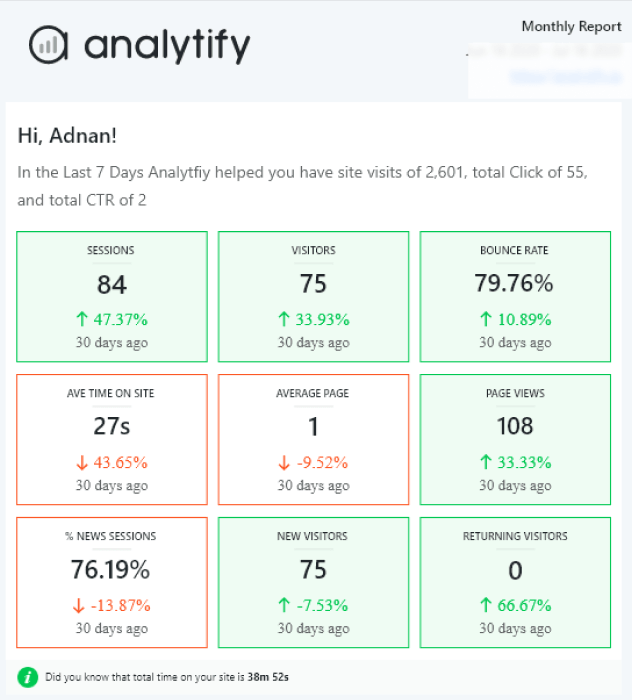
This makes it easier to shift from reactive reporting to a more strategic, forward-looking approach.
The result is simple: clearer insights, faster decisions, and a stronger connection between data and growth.
Many GA4 dashboards present users with excessive data and numerous reports, often lacking sufficient emphasis on critical metrics.
Most users have to navigate multiple reports, filters, and dimensions to find the metrics that matter. In that process, important growth signals often get lost.
Analytify removes that complexity by bringing the most relevant signal metrics into a single, clean view.
Instead of digging through raw data, you can immediately see the growth indicators that reflect user behavior, engagement, and conversions.
It focuses on clarity over volume. You don’t need to interpret dozens of reports to understand what is happening.
The key marketing indicators are presented upfront, so you can spot trends without friction.
This approach improves growth signal analytics in a practical way. When data is organized and easy to read, it becomes easier to:
- Recognize patterns in user behavior
- Identify changes in engagement early
- Focus on metrics that influence outcomes
- Make decisions with confidence instead of guesswork
The goal is not more data, but clearer signals that help you understand what drives growth.
Real-World Growth Signal Example
The following example demonstrates how growth signal tracking works in a real-world (SaaS) company context.
Scenario: SaaS User Growth Signals
A SaaS product is used to monitor user onboarding and retention metrics. Some of the observed growth signals tracked:
- Increased onboarding completion rate
- Increased return sessions within 7 days
- Revenue spike after 45 days
Signal points towards the outcome timeline.
Week 1–2: Onboarding Signals
This serves as a strong leading indicator in marketing, demonstrating that users understand and adopt the product early on.
- More users complete onboarding
- Activation rates improve
Week 2–4: Engagement Signals
These growth indicators confirm sustained user interest and perceived product value.
- Users return within 7 days
- Session depth increases
- Feature usage grows
Week 4–6: Conversion Signals
These metrics are key signals that reflect user intent translating into concrete actions.
- More users upgrade to paid plans
- Trial-to-paid conversion increases
Week 6–8: Revenue Impact
This is the lagging outcome driven by earlier signals.
- Revenue starts to increase
- Customer lifetime value improves
When to Shift From Reporting to Growth Signal Tracking
When you notice stagnant engagement or unpredictable user behavior, it is a sign that traditional reports are no longer enough.
These moments are a clear signal to shift your strategy toward growth signal tracking.
While basic reporting is great for checking past performance, it often misses the real pattern of a growing business.
Let’s analyze some of the signs that you should shift from basic analytics reporting towards growth signal tracking:
1. High Engagement with Flat Revenue
It is common to see a spike in user activity that doesn’t translate into a corresponding spike in sales. This gap suggests that while your content is interesting, your conversion funnel has a hurdle.
The Action: Analyze leading marketing indicators to identify exactly where users are dropping off in the funnel.
2. Traffic Growth Without Conversion Lift
If your traffic is trending upwards but your sign-ups aren’t seeing any increase, you are likely attracting the wrong audience. This showcases that your marketing is reaching people with low purchase intent or misaligned interests.
The Action: Shift your focus to intent-based metrics, such as pricing page views and detailed behavioral patterns, to filter out casual browsers and identify high-value visitors.
3. Scaling Ads Without Better Lead Quality
Increasing your ad spend should improve your bottom line. If you are paying for more clicks but seeing lower-quality leads, your traditional reporting is failing to show the full picture.
The Action: You must track predictive growth metrics that prove actual value, including:
- Trial activation rates
- Demo requests
- High-intent Qualified Sessions
4. Stakeholder Requests for Revenue Forecasts
As a business grows, leadership moves away from asking “What happened?” and starts asking “What’s next?” and that is when basic reports cannot answer future-oriented questions like:
“What will our revenue look like next quarter?”
“Which specific channels will drive our growth in six months?”
To answer these, you must rely on growth signal analytics. By trusting leading indicators and behavioral trends, you can produce accurate forecasts that stakeholders can bank on.
If your organization is experiencing growth in traffic without a rise in revenue, or if you find yourself needing future-oriented predictions rather than retrospective summaries, it is time to change your approach.
Transitioning from reactive reporting to growth signal tracking allows you to focus on the metrics that actually predict long-term organizational success.
FAQs on Growth Signal Tracking
What metrics predict business growth?
Metrics that predict business growth are leading indicators and behavior-based signal metrics. These show user intent before revenue appears.
Common predictive metrics include:
Trial sign-ups
Demo requests
Product page visits
Returning users
Session depth and engagement rate
Email engagement
Micro-conversions (clicks, form starts, video views)
What are leading indicators vs lagging indicators?
Leading indicators and lagging indicators measure different stages of growth.
Leading indicators measure user behavior and intent.
Examples: demo requests, trial sign-ups, engagement
Help predict future outcomes
Used in growth signal tracking
Lagging indicators measure final results
Examples: revenue, conversions, closed deals
Show what has already happened
Used for reporting and validation
Leading indicators help you act early, whilst lagging indicators confirm results after the fact.
What is growth signal analytics?
Growth signal analytics is the process of analyzing user behavior and key signal metrics to identify patterns that predict business growth.
It focuses on:
Leading indicators
Engagement trends
Conversion intent
Predictive growth metrics
It helps you understand which actions users take before they convert, so you can optimize for those behaviors and improve outcomes.
How to find predictive growth metrics?
You can identify predictive growth metrics by analyzing real user behavior and testing patterns over time.
Step-by-step approach:
Identify your conversion goal
Define what counts as success (purchase, signup, trial).
Map the user journey
List all actions users take before converting.
Segment high-value users
Study users who convert and analyze their behavior.
Track micro-conversions
Monitor small actions like clicks, scrolls, and form starts.
Compare patterns over time
Look for consistent behaviors across converting users.
Validate signals with data
Check if these behaviors correlate with conversions over 30–60 days.
The goal is to find growth indicators that reliably predict future outcomes, not any random activity.
Growth Signal Tracking: Conclusion
The difference between teams that scale and teams that stall is simple: one tracks what happened, the other tracks what’s coming.
With growth signal tracking, you learn to identify leading indicators and predictive growth metrics that reveal what is likely to happen next.
With the right growth signal analytics, you move from reactive reporting to proactive decision-making.
This helps you optimize faster, reduce guesswork, and align your strategy with real user actions.
Analytify makes this easier by surfacing your most important growth signals directly inside WordPress, no GA4 expertise required.
So instead of asking what happened, you start asking what will happen next.
This is all for this post. For more related posts, check:
- Predictive Analytics for WordPress: How to Forecast Website Growth with GA4 (2026)
- 11 Powerful Organic Growth Business Strategies to Boost Your Business
- The Comprehensive 9-Step ECommerce Website Audit Checklist For Growth in 2026
What growth signals are you currently tracking, and are they truly predicting your success?